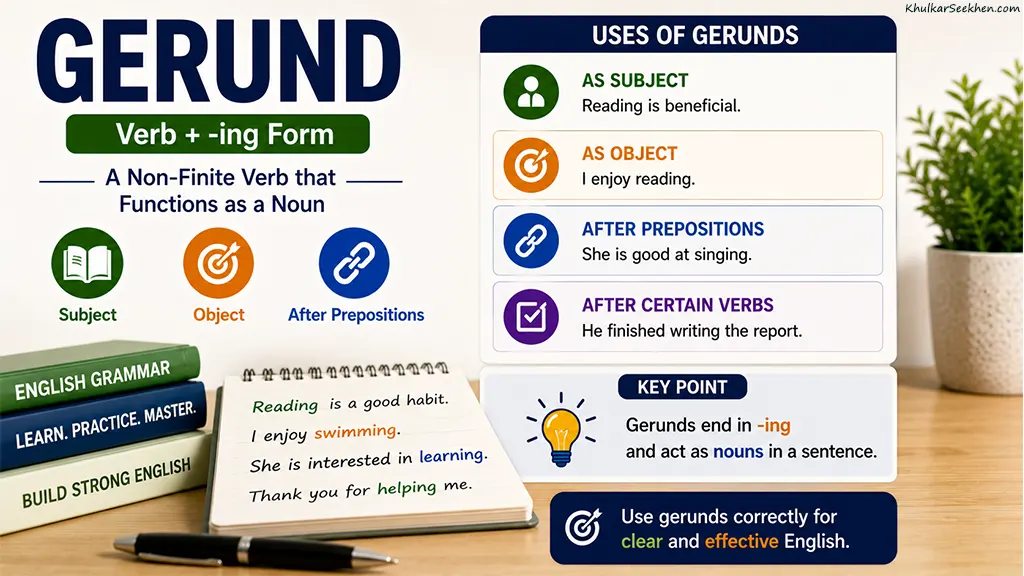
A Gerund is one of the three types of Non-finite Verbs. It is formed by adding -ing to the base form of a verb, but it functions as a noun rather than as a verb.
Although a gerund looks like a present participle, its function is different. Understanding this difference is essential for writing and speaking correct English.
In this lesson, you will learn:
- What is a Gerund?
- Formation of Gerunds
- Uses of Gerunds
- Gerund vs Present Participle
- Gerund vs Infinitive
- Verbs followed by Gerunds
- Common mistakes
- Exercises with answers
What is a Gerund?
Read the following sentences.
- Reading is a good habit.
- I enjoy playing cricket.
- Swimming keeps us healthy.
- She loves dancing.
The highlighted words are Gerunds.
Although they are formed from verbs, they function as nouns.
Definition
A Gerund is the -ing form of a verb that functions as a noun in a sentence.
Examples:
- reading
- writing
- swimming
- dancing
- walking
Formation of a Gerund
A gerund is formed by adding -ing to the base form (V1) of a verb.
| Base Verb (V1) | Gerund |
|---|---|
| read | reading |
| write | writing |
| swim | swimming |
| dance | dancing |
| play | playing |
Uses of Gerunds
A gerund can perform different functions in a sentence.
1. Gerund as the Subject
A gerund can be the subject of a sentence.
Examples:
- Reading improves knowledge.
- Swimming is good exercise.
- Walking keeps us fit.
Here, the gerunds act as nouns and are the subjects of the sentences.
2. Gerund as the Object
A gerund can be the object of a verb.
Examples:
- I enjoy reading.
- She likes dancing.
- They avoid wasting time.
3. Gerund After a Preposition
A gerund is used after a preposition.
Examples:
- He is interested in learning English.
- She succeeded by working hard.
- Thank you for helping me.
- They left without saying goodbye.
Rule: If a verb follows a preposition (such as in, on, at, for, by, after, before, without), use the gerund (-ing form).
4. Gerund as the Object of a Preposition
Examples:
- She is fond of singing.
- They are good at solving puzzles.
- We are excited about travelling.
5. Gerund After Certain Verbs
Some verbs are commonly followed by a gerund.
Examples include:
- enjoy
- avoid
- finish
- keep
- suggest
- admit
- consider
- mind
- practise
- imagine
Sentences:
- I enjoy reading novels.
- She finished writing the report.
- We suggested visiting the museum.
Gerund vs Present Participle
Many students confuse gerunds with present participles because both end in -ing.
The difference lies in their function, not their form.
| Gerund | Present Participle |
|---|---|
| Functions as a noun | Functions as an adjective or forms continuous tenses |
| Reading is enjoyable. | The reading boy is my brother. |
| Swimming is healthy. | The swimming child waved at us. |
Compare:
Gerund
- Reading is fun.
(Reading is the subject.)
Present Participle
- The reading student is my friend.
(Reading describes student.)
Gerund vs Infinitive
Both gerunds and infinitives can act as nouns, but they are used differently after certain verbs.
| Gerund | Infinitive |
|---|---|
| reading | to read |
| swimming | to swim |
| I enjoy reading. | I want to read. |
| Ends in -ing | Usually begins with to |
Verbs Commonly Followed by Gerunds
- enjoy
- avoid
- finish
- suggest
- practise
- admit
- consider
- keep
- imagine
Verbs Commonly Followed by Infinitives
- decide
- hope
- agree
- promise
- want
- plan
- refuse
- wish
- manage
- learn
Some Verbs Can Take Both
Certain verbs can be followed by either a gerund or an infinitive.
Examples:
- begin
- start
- continue
- like
- love
- hate
Sentences:
- She started studying.
- She started to study.
In many cases, both forms are acceptable with little or no change in meaning.
Note: Some verbs (such as remember, forget, stop, and try) can take both forms but with a change in meaning. These are usually covered in advanced grammar.
Common Mistakes
✘ I enjoy to play cricket.
✔ I enjoy playing cricket.
✘ She is interested to learn English.
✔ She is interested in learning English.
✘ He finished to write the letter.
✔ He finished writing the letter.
✘ They suggested to go home.
✔ They suggested going home.
✘ We left without say goodbye.
✔ We left without saying goodbye.
Quick Revision Table
| Use | Example |
|---|---|
| Subject | Reading is useful. |
| Object | I enjoy reading. |
| After Preposition | She is good at singing. |
| After Certain Verbs | He finished writing. |
| Object of Preposition | They succeeded by working hard. |
Summary
- A Gerund is the -ing form of a verb that functions as a noun.
- Gerunds can act as the subject, object, or object of a preposition.
- Gerunds are commonly used after prepositions and certain verbs such as enjoy, avoid, and finish.
- Although gerunds and present participles look alike, they have different functions.
- Some verbs are followed by gerunds, while others are followed by infinitives.
Practice Exercise 1
Identify the gerund and state its function.
- Reading improves vocabulary.
- I enjoy swimming every morning.
- She is interested in learning French.
- Walking is good exercise.
- They avoided making unnecessary mistakes.
- Thank you for helping me.
- Singing makes her happy.
- He finished painting the wall.
- We succeeded by working together.
- Dancing is her favourite hobby.
Practice Exercise 2
Choose the correct answer.
- A gerund functions as a:
- (a) verb
- (b) adjective
- (c) noun
- (d) adverb
- Which sentence contains a gerund?
- (a) The running boy won the race.
- (b) Running is healthy.
- (c) She is running fast.
- (d) The train is running late.
- Which verb is usually followed by a gerund?
- (a) decide
- (b) promise
- (c) enjoy
- (d) hope
- Which sentence is correct?
- (a) I enjoy to read novels.
- (b) I enjoy reading novels.
- (c) I enjoy read novels.
- (d) I enjoy to reading novels.
- Which sentence uses a gerund after a preposition?
- (a) He wants to study.
- (b) She enjoys singing.
- (c) They are interested in learning.
- (d) We can swim.
Answers Exercise 1
- Reading – Subject
- swimming – Object
- learning – Object of the preposition (in)
- Walking – Subject
- making – Object
- helping – Object of the preposition (for)
- Singing – Subject
- painting – Object
- working – Object of the preposition (by)
- Dancing – Subject
Answers Exercise 2
- (c) noun
- (b) Running is healthy.
- (c) enjoy
- (b) I enjoy reading novels.
- (c) They are interested in learning.
