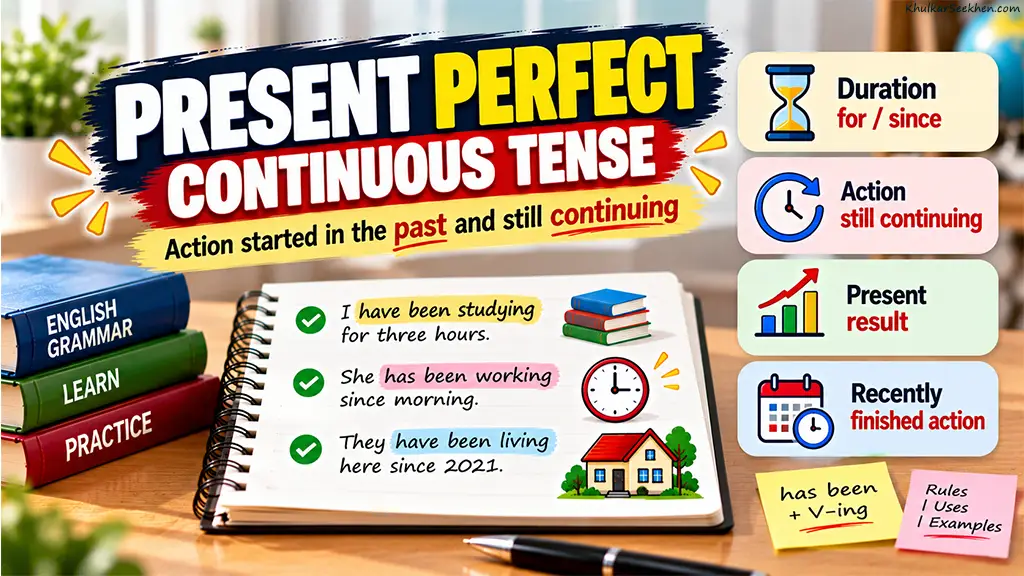
The Present Perfect Continuous Tense is used to describe an action that started in the past, is still continuing in the present, or has recently stopped but its effects are still visible.
This tense emphasizes the duration of an action rather than its completion.
For example:
- I have been studying for three hours.
- She has been working since morning.
Here, the action began in the past and continues up to the present.
In this lesson, you will learn:
- What is the Present Perfect Continuous Tense?
- Sentence structure
- Uses with examples
- Since vs For
- Signal words
- Present Perfect vs Present Perfect Continuous
- Common mistakes
- Exercises with answers
What is the Present Perfect Continuous Tense?
Read the following sentences.
- The peacock has been dancing since morning.
- Rahul has been studying for two hours.
- They have been living in this city since 2021.
- I have been waiting for you.
- Have you been exercising regularly?
All these sentences describe actions that began in the past and are still continuing or have just finished with a visible result.
Definition
The Present Perfect Continuous Tense is used to describe an action that started in the past and is still continuing, or has recently stopped but has a present result.
It is formed using:
has/have + been + verb + ing
Structure of the Present Perfect Continuous Tense
1. Affirmative Sentences
| Subject | Helping Verb | Main Verb |
|---|---|---|
| I/We/You/They | have been | V-ing |
| He/She/It | has been | V-ing |
Examples:
- I have been reading for an hour.
- We have been waiting since morning.
- She has been working all day.
- Rahul has been playing cricket.
2. Negative Sentences
| Subject | Helping Verb | Not | Main Verb |
|---|---|---|---|
| I/We/You/They | have been | not | V-ing |
| He/She/It | has been | not | V-ing |
Examples:
- I have not been sleeping well.
- She has not been attending classes.
- They have not been working today.
3. Interrogative Sentences
| Helping Verb | Subject | Main Verb |
|---|---|---|
| Have | I/We/You/They | been + V-ing |
| Has | He/She/It | been + V-ing |
Examples:
- Have you been studying?
- Has she been crying?
- Have they been waiting?
4. WH-Questions
WH Word + has/have + subject + been + V-ing?
Examples:
- Why have you been laughing?
- How long has she been working here?
- What have they been doing?
- Where has Rahul been staying?
When to Use the Present Perfect Continuous Tense
1. Action Started in the Past and Still Continues
This is the most common use.
Examples:
- I have been learning English for five years.
- She has been living in Delhi since 2022.
- They have been playing since 4 p.m.
2. To Emphasize Duration
The focus is on how long an action has continued.
Examples:
- We have been waiting for two hours.
- He has been driving since morning.
- My father has been working in this company for twenty years.
3. Recently Finished Action with Present Result
The action has just stopped, but its result is visible.
Examples:
- She is tired because she has been running.
- The ground is wet because it has been raining.
- His hands are dirty because he has been repairing the bicycle.
4. Repeated Action Over a Period
Examples:
- I have been calling you all day.
- They have been visiting us frequently.
- She has been asking the same question again and again.
Since vs For
One of the most important concepts in this tense.
Use Since for a Starting Point
| Since | Examples |
|---|---|
| since 2020 | since 2020 |
| since Monday | since Monday |
| since 8 a.m. | since 8 a.m. |
| since childhood | since childhood |
Examples:
- I have been living here since 2018.
- She has been teaching since July.
Use For for a Period of Time
| For | Examples |
|---|---|
| for two hours | for two hours |
| for a week | for a week |
| for many years | for many years |
| for a long time | for a long time |
Examples:
- We have been studying for three hours.
- They have been working for ten years.
Signal Words
These expressions often indicate the Present Perfect Continuous Tense.
- since
- for
- all day
- all morning
- all week
- lately
- recently
- how long
Examples:
- She has been reading all day.
- We have been waiting for an hour.
Present Perfect vs Present Perfect Continuous
| Present Perfect | Present Perfect Continuous |
|---|---|
| Focuses on completion | Focuses on duration |
| I have painted the wall. | I have been painting the wall. |
| Work is completed. | Work may still be continuing. |
| Result is important. | Process is important. |
Examples:
Present Perfect
- I have cleaned my room.
(The room is clean.)
Present Perfect Continuous
- I have been cleaning my room for two hours.
(The emphasis is on the time spent cleaning.)
Verbs Normally Not Used in This Tense
Stative verbs generally do not appear in the Present Perfect Continuous.
Examples include:
- know
- believe
- understand
- love
- hate
- own
- belong
- want
- need
- remember
- prefer
Correct:
- I have known him for ten years.
- She has owned this house since 2019.
Incorrect:
- I have been knowing him for ten years.
- She has been owning this house since 2019.
Common Mistakes
✘ I have been living here since five years.
✔ I have been living here for five years.
✘ She has been working for Monday.
✔ She has been working since Monday.
✘ He have been studying.
✔ He has been studying.
✘ They has been playing.
✔ They have been playing.
✘ I have been knowing him for years.
✔ I have known him for years.
Quick Revision Table
| Sentence Type | Structure |
|---|---|
| Affirmative | Subject + has/have been + V-ing |
| Negative | Subject + has/have not been + V-ing |
| Interrogative | Has/Have + Subject + been + V-ing? |
| WH-Question | WH + has/have + Subject + been + V-ing? |
Summary
- The Present Perfect Continuous Tense describes an action that began in the past and continues into the present, or has recently finished with a visible result.
- It is formed using has/have been + verb + ing.
- Use since for a starting point and for for a period of time.
- It emphasizes the duration or continuity of an action.
- Stative verbs such as know, believe, and own are generally not used in this tense.
Practice Exercise 1
Fill in the blanks with the correct form of the verb.
- She ________ (study) for three hours.
- I ________ (live) here since 2020.
- They ________ (play) cricket since morning.
- Rahul ________ (not/work) today.
- ________ you ________ (wait) for me?
- How long ________ she ________ (teach) at this school?
- We ________ (learn) English for five years.
- The children ________ (watch) television all evening.
- It ________ (rain) since yesterday.
- My father ________ (drive) for six hours.
Practice Exercise 2
Choose the correct answer.
- Which structure is correct?
- (a) has been + V¹
- (b) has been + V-ing
- (c) has + V²
- (d) has + V¹
- Which sentence is correct?
- (a) She has been work here.
- (b) She has been working here.
- (c) She has working here.
- (d) She been working here.
- Which word shows a starting point?
- (a) for
- (b) since
- (c) during
- (d) by
- Which sentence is correct?
- (a) I have been living here since five years.
- (b) I have been living here for five years.
- (c) I have been lived here for five years.
- (d) I have living here for five years.
- Which sentence shows a recently finished action with a present result?
- (a) She has been running, so she is tired.
- (b) She ran yesterday.
- (c) She runs every morning.
- (d) She will run tomorrow.
Answers Exercise 1
- has been studying
- have been living
- have been playing
- has not been working
- Have, been waiting
- has, been teaching
- have been learning
- have been watching
- has been raining
- has been driving
Answers Exercise 2
- (b) has been + V-ing
- (b) She has been working here.
- (b) since
- (b) I have been living here for five years.
- (a) She has been running, so she is tired.
