Punctuation marks are symbols used in writing to make the meaning of sentences clear, accurate, and easy to understand. Correct punctuation improves readability and prevents misunderstandings.
Consider these two sentences:
✘ It’s time to eat Radha.
✔ It’s time to eat, Radha.
In the first sentence, it appears that someone is going to eat Radha. In the second sentence, the comma shows that Radha is being addressed.
This example shows how a single punctuation mark can completely change the meaning of a sentence.
What are Punctuation Marks?
Punctuation Marks are symbols used in writing to separate ideas, organize sentences, indicate pauses, and express meaning clearly.
In Hindi, punctuation marks are called विराम चिह्न.
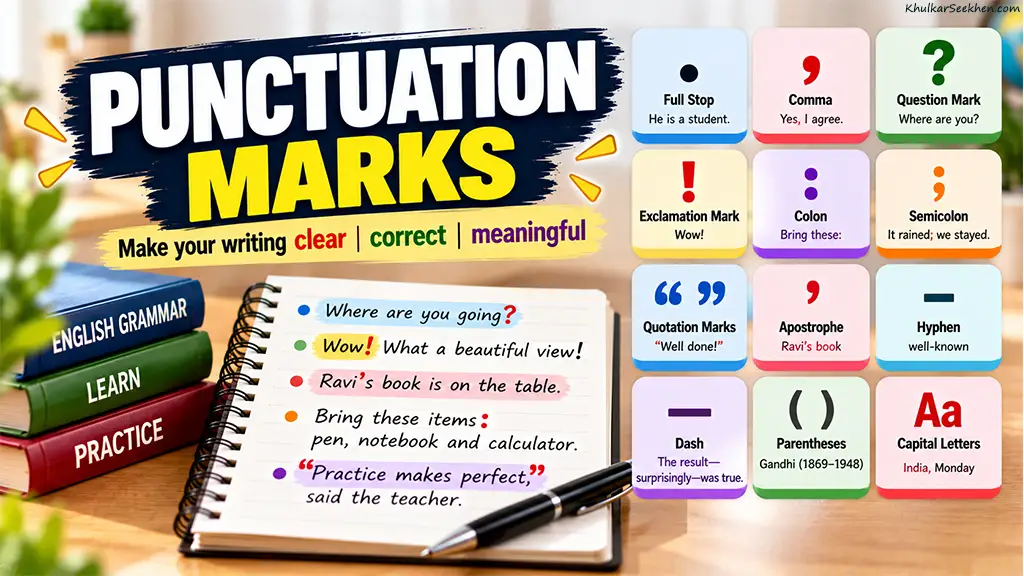
Common Punctuation Marks
| Symbol | Name |
|---|---|
| . | Full Stop (Period) |
| , | Comma |
| ? | Question Mark |
| ! | Exclamation Mark |
| : | Colon |
| ; | Semicolon |
| ” “ | Quotation Marks |
| ‘ | Apostrophe |
| – | Hyphen |
| — | Dash |
| ( ) | Parentheses |
| CAPITALS | Capital Letters |
1. Capital Letters
Capital letters are used at the beginning of sentences and for proper nouns.
Rules for Capital Letters
Rule 1: Beginning of a Sentence
The first word of every sentence begins with a capital letter.
Examples:
- We go to school by bus.
- Did you finish your homework?
Rule 2: Proper Nouns
Use capital letters for names of:
- People
- Countries
- Cities
- Rivers
- Mountains
- Languages
- Religions
- Books
- Newspapers
- Days
- Months
Examples:
- India
- Delhi
- Monday
- English
- The Hindu
- the Ganga
- Mount Everest
Note: Write Mount Everest, not the Mount Everest.
Rule 3: Official Titles Before Names
Examples:
- Prime Minister Narendra Modi
- President Droupadi Murmu
- Principal Sharma
Rule 4: Pronoun “I”
The pronoun I is always written in capital letters.
✔ Ravi and I are friends.
Rule 5: Direct Speech
The first word inside quotation marks begins with a capital letter.
✔ He said, “What are you doing?”
2. Full Stop (.)
A Full Stop (Period) is used at the end of a complete statement.
Examples:
- She is a doctor.
- Please sit down.
- He asked where I lived.
It is also used in many abbreviations (style depends on the writing format).
Examples:
- Dr.
- Mr.
- Mrs.
- M.A.
- Ph.D.
3. Question Mark (?)
A Question Mark is used at the end of a direct question.
Examples:
- Where do you live?
- Are you ready?
- Who is your teacher?
Do not use a question mark in indirect questions.
✔ He asked where I lived.
✘ He asked where I lived?
4. Comma (,)
A comma indicates a short pause.
Uses of Comma
In Lists
- Apples, oranges, bananas, and grapes.
After Introductory Words
- Yes, I agree.
- No, I don’t.
Direct Address
- Rahul, come here.
- Please help me, Sir.
Apposition
- Mahatma Gandhi, the Father of the Nation, inspired millions.
Direct Speech
- He said, “I am ready.”
Dates
- August 15, 1947
5. Quotation Marks (” “)
Quotation marks enclose the exact words spoken by someone.
Examples:
- Riya said, “I will help you.”
- “Practice makes perfect,” said the teacher.
Single quotation marks are often used for titles mentioned within sentences (style may vary).
Examples:
- I read ‘The Last Leaf’ yesterday.
- She wrote an essay on ‘Global Warming’.
6. Apostrophe (‘)
The apostrophe has two main uses.
A. Contractions
- don’t
- can’t
- it’s
- I’m
- we’ll
B. Possession
Singular Noun
- Rahul’s book
- Priya’s bag
Plural Noun Ending in s
- girls’ hostel
- teachers’ room
Irregular Plural
- men’s shoes
- children’s books
- women’s hostel
7. Exclamation Mark (!)
Used after strong emotions.
Joy
Hurrah!
Surprise
Wow!
Pain
Ouch!
Sorrow
Alas!
Strong Wishes
- May God bless you!
- What a beautiful painting!
8. Colon (:)
A colon introduces a list, explanation, or quotation.
Examples:
Bring these items:
- Pen
- Notebook
- Calculator
He said:
“Knowledge is power.”
9. Semicolon (;)
A semicolon joins two closely related independent clauses.
Examples:
- It was raining; we stayed indoors.
- She worked hard; therefore, she succeeded.
It is also useful in long lists that already contain commas.
10. Hyphen (-)
A hyphen joins words to form compound words.
Examples:
- mother-in-law
- well-known
- check-in
- twenty-one
- eighty-six
11. Dash (—)
A dash adds emphasis or extra information.
Examples:
- The answer—surprisingly—was correct.
- One thing is certain—we must act now.
A dash is longer than a hyphen.
12. Parentheses ( )
Parentheses contain additional information.
Examples:
- Mahatma Gandhi (1869–1948) led India’s freedom movement.
- Mount Bastion (3,954 m) is in the Canadian Rockies.
Common Mistakes
✘ its time to eat, Radha.
✔ It’s time to eat, Radha.
✘ where are you going.
✔ Where are you going?
✘ wow what a beautiful flower
✔ Wow! What a beautiful flower!
✘ the Mount Everest
✔ Mount Everest
✘ children come here
✔ Children, come here.
✘ yes I know
✔ Yes, I know.
Quick Revision Table
| Mark | Main Use | Example |
|---|---|---|
| . | Statement | He is a doctor. |
| ? | Question | Where are you? |
| ! | Emotion | Hurrah! |
| , | Short pause | Yes, I agree. |
| : | List | Bring: books, pens |
| ; | Related clauses | It rained; we stayed home. |
| ” “ | Direct speech | “Come here,” she said. |
| ‘ | Possession | Ravi’s bag |
| – | Compound word | well-known |
| — | Extra information | He—the captain—arrived. |
| ( ) | Additional information | Gandhi (1869–1948) |
Summary
- Punctuation marks make writing clear, accurate, and meaningful.
- Every sentence should end with the correct punctuation mark.
- Capital letters begin sentences and proper nouns.
- Commas separate ideas and indicate pauses.
- Question marks are used only for direct questions.
- Quotation marks show direct speech.
- Apostrophes indicate possession or omitted letters.
- Colons, semicolons, hyphens, dashes, and parentheses organize information effectively.
Practice Exercise 1
Rewrite the following sentences using correct punctuation.
- caesar having defeated his enemies returned home
- children today you have to write an essay on global warming said the teacher
- alas i have lost my loving kitten
- may god bless you and help you succeed
- who was the author of the book two states
- let us plant trees to protect the environment
- dont smoke as it is injurious to health
- kavita and seema are my best friends
- crores of people took a holy dip in triveni sangam prayagraj
- oh i wish i could meet my mother again
Practice Exercise 2
Choose the correct punctuation mark.
- Which punctuation mark ends a direct question?
- (a) .
- (b) !
- (c) ?
- (d) :
- Which punctuation mark shows possession?
- (a) ,
- (b) ‘
- (c) ;
- (d) –
- Which punctuation mark is used for direct speech?
- (a) Parentheses
- (b) Quotation Marks
- (c) Colon
- (d) Dash
- Which sentence is correctly punctuated?
- (a) Wow what a beautiful view.
- (b) Wow! What a beautiful view!
- (c) Wow? What a beautiful view.
- (d) Wow, What a beautiful view.
- Which punctuation mark introduces a list?
- (a) :
- (b) ;
- (c) ?
- (d) ‘
Answers Exercise 1
- Caesar, having defeated his enemies, returned home.
- “Children, today you have to write an essay on ‘Global Warming’,” said the teacher.
- Alas! I have lost my loving kitten.
- May God bless you and help you succeed!
- Who was the author of the book Two States?
- Let us plant trees to protect the environment.
- Don’t smoke, as it is injurious to health.
- Kavita and Seema are my best friends.
- Crores of people took a holy dip at Triveni Sangam, Prayagraj.
- Oh! I wish I could meet my mother again.
Answers Exercise 2
- (c) ?
- (b) ‘
- (b) Quotation Marks
- (b) Wow! What a beautiful view!
- (a) :
