The Present Continuous Tense (also called the Present Progressive Tense) is used to describe actions that are happening at the moment of speaking, temporary situations, and planned future arrangements.
Unlike the Simple Present Tense, which describes habits and routines, the Present Continuous Tense focuses on actions that are in progress.
In this lesson, you will learn:
- What is the Present Continuous Tense?
- Sentence structure
- Rules for using am, is, are
- Formation of -ing verbs
- Uses with examples
- Stative verbs
- Common mistakes
- Exercises with answers
What is the Present Continuous Tense?
Read the following sentences.
- Rachel is throwing waste into the dustbin.
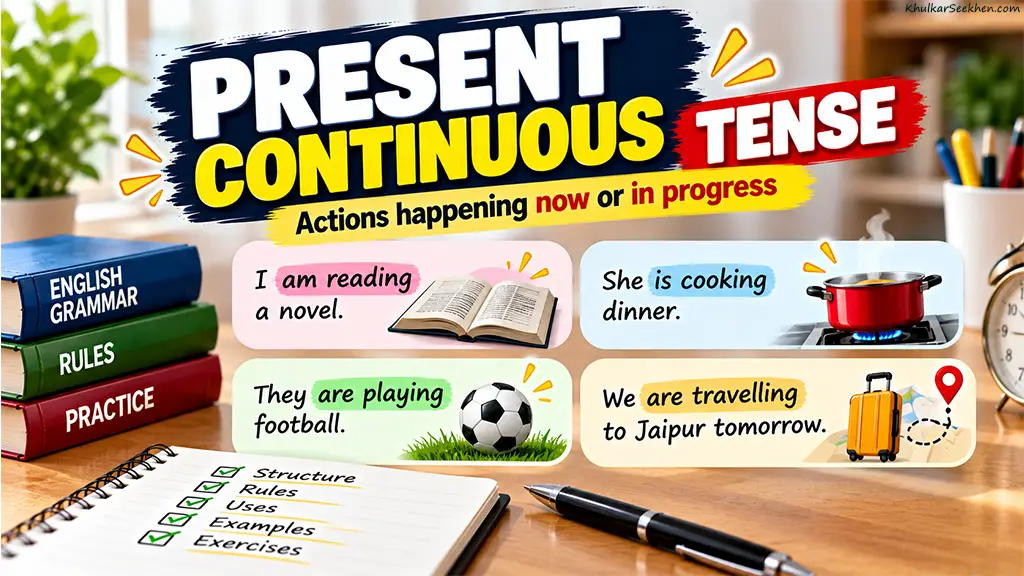
- I am reading a novel.
- They are playing football.
- We are learning English.
- Is she preparing for the examination?
These sentences describe actions that are happening right now.
Definition
The Present Continuous Tense is used to describe actions that are happening now, temporary situations, changing situations, and planned future events.
It is formed using am/is/are + verb + ing.
Structure of the Present Continuous Tense
1. Affirmative Sentences
| Subject | Helping Verb | Main Verb |
|---|---|---|
| I | am | V-ing |
| He/She/It | is | V-ing |
| We/You/They | are | V-ing |
Examples:
- I am studying English.
- She is cooking dinner.
- They are playing cricket.
- We are watching a movie.
2. Negative Sentences
| Subject | Helping Verb | Not | Main Verb |
|---|---|---|---|
| I | am | not | V-ing |
| He/She/It | is | not | V-ing |
| We/You/They | are | not | V-ing |
Examples:
- I am not sleeping.
- She is not singing.
- They are not working today.
3. Interrogative Sentences
| Helping Verb | Subject | Main Verb |
|---|---|---|
| Am | I | V-ing |
| Is | He/She/It | V-ing |
| Are | We/You/They | V-ing |
Examples:
- Are you listening?
- Is she writing a letter?
- Are they studying?
4. WH-Questions
WH Word + am/is/are + Subject + V-ing?
Examples:
- Why are you laughing?
- What is she doing?
- Where are they going?
- When is the train arriving?
Formation of the -ing Form
Most verbs simply add -ing.
| Base Verb | -ing Form |
|---|---|
| play | playing |
| read | reading |
| sing | singing |
| jump | jumping |
Rule 1: Drop Final e
Remove e and add -ing.
| Base Verb | -ing Form |
|---|---|
| write | writing |
| make | making |
| drive | driving |
| take | taking |
Rule 2: Double the Final Consonant
If a one-syllable verb ends in consonant-vowel-consonant (CVC), double the last consonant.
| Base Verb | -ing Form |
|---|---|
| run | running |
| sit | sitting |
| stop | stopping |
| swim | swimming |
Do not double w, x, or y.
Examples:
- snow → snowing
- fix → fixing
- play → playing
Rule 3: Verbs Ending in ie
Change ie to y and add -ing.
| Base Verb | -ing Form |
|---|---|
| lie | lying |
| die | dying |
| tie | tying |
Uses of the Present Continuous Tense
1. Actions Happening Right Now
The most common use.
Examples:
- She is reading a newspaper.
- The children are playing outside.
- I am writing an email.
2. Temporary Situations
Situations that are not permanent.
Examples:
- I am staying with my uncle this week.
- She is working in Mumbai for a few months.
- They are living in a rented apartment.
3. Changing or Developing Situations
Examples:
- The climate is changing rapidly.
- Technology is improving every year.
- Prices are increasing.
4. Planned Future Arrangements
Used for personal plans that have already been arranged.
Examples:
- I am meeting my teacher tomorrow.
- We are travelling to Jaipur next week.
- She is flying to Delhi on Friday.
5. Repeated Actions (with “always”)
Used to express irritation, annoyance, or criticism.
Examples:
- He is always complaining.
- She is always losing her keys.
- They are always arriving late.
Time Expressions (Signal Words)
These words often indicate the Present Continuous Tense.
- now
- right now
- at the moment
- currently
- today
- this week
- these days
- tonight
- still
- nowadays
Examples:
- She is studying now.
- We are working at the moment.
Stative Verbs
Some verbs usually do not take the continuous form because they describe states, not actions.
Common stative verbs include:
- know
- believe
- understand
- remember
- forget
- like
- love
- hate
- prefer
- own
- belong
- need
- want
- seem
- appear
Correct
- I know the answer.
- She likes music.
- This book belongs to me.
Incorrect
- I am knowing the answer.
- She is liking music.
- This book is belonging to me.
Note: Some stative verbs can be used in the continuous tense when their meaning changes. For example, I’m having lunch (have = eat) is correct, but I have a car (have = possess) is not written as I am having a car.
Present Continuous vs Simple Present
| Simple Present | Present Continuous |
|---|---|
| Habit or routine | Action happening now |
| She walks to school every day. | She is walking to school now. |
| Permanent situation | Temporary situation |
| General truth | Action in progress |
Common Mistakes
✘ He is play football.
✔ He is playing football.
✘ I am go to school.
✔ I am going to school.
✘ They is studying.
✔ They are studying.
✘ She are reading.
✔ She is reading.
✘ I am knowing the answer.
✔ I know the answer.
✘ He is coming every day to school.
✔ He comes to school every day.
(Use the Simple Present for habits.)
Quick Revision Table
| Sentence Type | Structure |
|---|---|
| Affirmative | Subject + am/is/are + V-ing |
| Negative | Subject + am/is/are + not + V-ing |
| Interrogative | Am/Is/Are + Subject + V-ing? |
| WH-Question | WH + am/is/are + Subject + V-ing? |
Summary
- The Present Continuous Tense describes actions happening now or around the present time.
- It is formed using am/is/are + verb + ing.
- It is used for actions in progress, temporary situations, changing situations, and planned future arrangements.
- Many stative verbs are generally not used in the continuous tense.
- Signal words such as now, currently, at the moment, and today often indicate this tense.
Practice Exercise 1
Fill in the blanks with the correct form of the verb.
- She ________ (read) a magazine now.
- I ________ (write) an email at the moment.
- They ________ (play) football in the park.
- Rahul ________ (not/watch) television now.
- ________ you ________ (listen) to the teacher?
- Why ________ she ________ (cry)?
- We ________ (prepare) for the annual function.
- My parents ________ (travel) to Chennai this weekend.
- The baby ________ (sleep) peacefully.
- The weather ________ (become) warmer.
Practice Exercise 2
Choose the correct answer.
- Which sentence is in the Present Continuous Tense?
- (a) She plays tennis.
- (b) She is playing tennis.
- (c) She played tennis.
- (d) She will play tennis.
- Which helping verb is used with I?
- (a) is
- (b) are
- (c) am
- (d) be
- Which sentence is correct?
- (a) They is studying.
- (b) They are studying.
- (c) They am studying.
- (d) They studying.
- Which verb is correctly written in the -ing form?
- (a) makeing
- (b) making
- (c) makking
- (d) makeing
- Which sentence uses the Present Continuous to describe a future arrangement?
- (a) I visit Delhi every year.
- (b) I am visiting Delhi next Monday.
- (c) I visited Delhi last year.
- (d) I will visit Delhi someday.
Answers Exercise 1
- is reading
- am writing
- are playing
- is not watching
- Are, listening
- is, crying
- are preparing
- are travelling (or traveling in American English)
- is sleeping
- is becoming
Answers Exercise 2
- (b) She is playing tennis.
- (c) am
- (b) They are studying.
- (b) making
- (b) I am visiting Delhi next Monday.
