Articles are among the most commonly used Determiners in English. They are placed before nouns to indicate whether the noun refers to a general thing or a particular thing.
Although English has only three articles (a, an, and the), using them correctly is one of the most challenging areas of grammar.
In this lesson, you will learn:
- What are Articles?
- Types of Articles
- Uses of A
- Uses of An
- Uses of The
- Zero Article (No Article)
- Common mistakes
- Exercises with answers
What is an Article?
Read the following sentences.
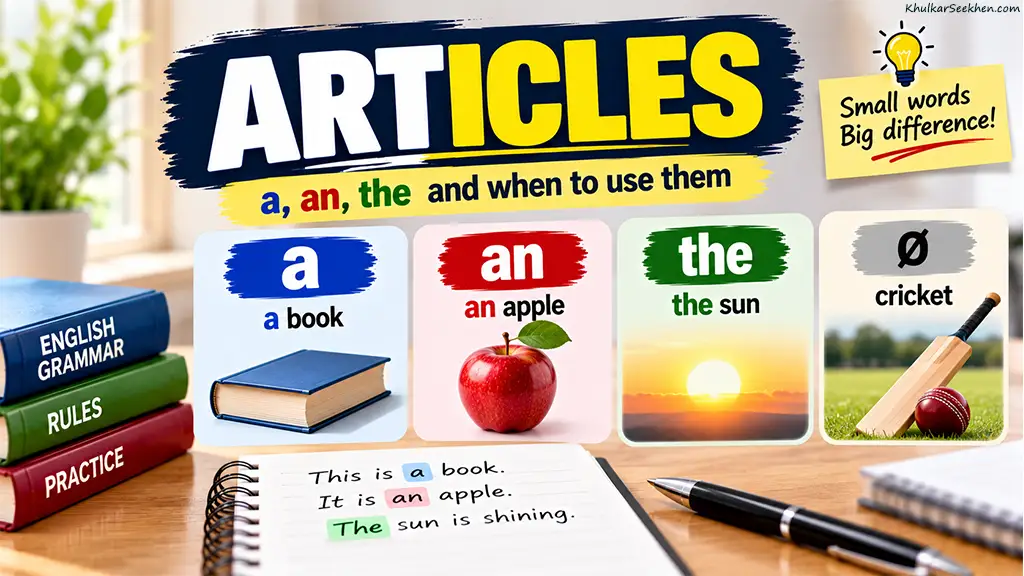
- This is a chair.
- Sita sings a song.
- This is an umbrella.
- This is an apple.
- The sun is shining.
The words a, an, and the come before nouns.
These words are called Articles.
Definition
An Article is a determiner placed before a noun to indicate whether the noun refers to a general or a specific person, place, animal, or thing.
Articles always come before nouns (or before adjectives that modify nouns).
Types of Articles
There are two types of articles.
- Indefinite Articles (A, An)
- Definite Article (The)
Indefinite Articles (A and An)
A and An are called Indefinite Articles because they refer to any one person, animal, place, or thing, not a particular one.
They are used only with singular countable nouns.
Examples
- This is a car.
- She is a teacher.
- It is an umbrella.
- He is an honest man.
A vs An
The choice between a and an depends on the sound, not the spelling.
Use A
Use a before words beginning with a consonant sound.
Examples
- a boy
- a book
- a teacher
- a university
- a European
- a useful book
- a one-rupee coin
Notice:
Although university, European, useful, and one begin with vowel letters (u, e, u, o), they begin with consonant sounds (/juː/, /w/).
Use An
Use an before words beginning with a vowel sound.
Examples
- an apple
- an umbrella
- an elephant
- an orange
Words Beginning with a Consonant Letter but a Vowel Sound
Use an before:
- an honest man
- an hour
- an heir
- an M.L.A.
- an M.B.A.
- an S.D.O.
- an L.L.B. student
- an X-ray
These words begin with vowel sounds even though their first letter is not a vowel.
Quick Comparison
| Use A | Use An |
|---|---|
| a university | an umbrella |
| a European | an apple |
| a useful book | an hour |
| a one-eyed man | an honest person |
| a union | an M.B.A. |
Rules for Using A and An
Rule 1: Before Singular Countable Nouns
- A dog is an animal.
- A peacock is a bird.
- An elephant is a large animal.
Rule 2: Before Adjectives
The article comes before the adjective.
Examples:
- a smart boy
- an intelligent girl
- an honest officer
Rule 3: With Certain Verb-Noun Expressions
Some verbs become nouns in fixed expressions.
Examples:
- have a walk
- take a bath
- have a rest
- go for a ride
- have a talk
Rule 4: After Such, Quite, Rather
Examples:
- such a beautiful flower
- quite an interesting book
- rather a difficult task
Rule 5: After So, As, Too, How + Adjective
Examples:
- so difficult a question
- too heavy a bag
- as clever a student as Ravi
- how beautiful a flower!
Rule 6: Proper Noun Used as a Common Noun
Sometimes a famous person’s name represents a quality.
Examples:
- He thinks he is a Shakespeare.
- She is an Einstein.
Here, the names do not refer to the actual people but to someone with similar qualities.
Definite Article (The)
The is called the Definite Article because it refers to a particular person, place, animal, or thing.
Rule 1: Something Already Mentioned
First mention:
I bought a book.
Second mention:
The book is interesting.
Rule 2: Unique Things
Examples:
- the Sun
- the Moon
- the Earth
- the sky
- the Taj Mahal
Rule 3: Superlative Degree
Examples:
- the tallest building
- the best player
- the most beautiful place
Rule 4: Ordinal Numbers
Examples:
- the first chapter
- the second prize
- the third question
Rule 5: Musical Instruments
Examples:
- play the guitar
- play the flute
- play the piano
Rule 6: Rivers, Seas, Oceans, Mountain Ranges
Examples:
- the Ganga
- the Yamuna
- the Nile
- the Indian Ocean
- the Himalayas
- the Alps
Note: Use no article with the names of individual mountains, e.g., Mount Everest, Mount Abu, Mount Fuji.
Rule 7: Newspapers and Holy Books
Examples:
- The Times of India
- The Hindu
- the Bible
- the Quran
- the Ramayana
- the Mahabharata
Rule 8: Families
Examples:
- the Sharmas
- the Guptas
- the Vermas
Rule 9: Government Posts and Offices
Examples:
- the President
- the Prime Minister
- the Principal
- the Chief Justice
Zero Article (No Article)
No article is used before:
Proper Names
- Rahul
- India
- Delhi
Languages
- English
- Hindi
- French
Subjects
- Mathematics
- History
- Physics
Meals (General)
- breakfast
- lunch
- dinner
But:
- The dinner served yesterday was excellent.
Sports
- cricket
- football
- badminton
Days and Months
- Monday
- January
- August
Pronunciation of “The”
“The” has two pronunciations.
| Pronunciation | Used Before |
|---|---|
| /ðə/ | Consonant sounds (the book, the school) |
| /ðiː/ | Vowel sounds (the apple, the elephant) |
We also pronounce the as /ðiː/ when we want to give special emphasis.
Example:
- He is the person I was talking about.
Common Mistakes
✘ an university
✔ a university
✘ a honest man
✔ an honest man
✘ the Mount Everest
✔ Mount Everest
✘ Ganga is holy.
✔ The Ganga is holy.
✘ I play the cricket.
✔ I play cricket.
✘ The breakfast is ready. (general meaning)
✔ Breakfast is ready.
✘ He is engineer.
✔ He is an engineer.
Quick Revision Table
| Article | Use | Example |
|---|---|---|
| a | Before consonant sounds | a university |
| an | Before vowel sounds | an umbrella |
| the | Particular things | the Sun |
| — | No article | India, English, breakfast |
Summary
- Articles are determiners placed before nouns.
- A and An are Indefinite Articles used with singular countable nouns.
- The is the Definite Article used for specific or previously mentioned nouns.
- The choice between a and an depends on pronunciation, not spelling.
- Some nouns take no article, such as proper names, languages, school subjects, meals (in a general sense), and sports.
Practice Exercise 1
Choose the correct article (a, an, the, or no article).
- Mount Everest is ________ highest peak in the world.
- Ravi is ________ honest man.
- She studies in ________ university.
- I bought ________ umbrella yesterday.
- ________ Earth revolves around ________ Sun.
- He is ________ M.B.A. graduate.
- I like playing ________ cricket.
- We had ________ wonderful evening yesterday.
- She can play ________ violin very well.
- I met him at ________ railway station.
Practice Exercise 2
Choose the correct option.
- He is ________ European citizen.
- (a) a
- (b) an
- (c) the
- (d) no article
- Which sentence is correct?
- (a) an university
- (b) a university
- (c) the university (when referring to any university)
- (d) university
- Which article is used before a superlative adjective?
- (a) a
- (b) an
- (c) the
- (d) no article
- Which sentence is correct?
- (a) The Mount Everest is the highest mountain.
- (b) Mount Everest is the highest mountain.
- (c) A Mount Everest is the highest mountain.
- (d) An Mount Everest is the highest mountain.
- Which sentence is correct?
- (a) He is an honest person.
- (b) He is a honest person.
- (c) He is the honest person. (general meaning)
- (d) He is honest person.
Answers Exercise 1
- the
- an
- a
- an
- The, the
- an
- — (no article)
- a
- the
- the
Answer Exercise 2
- (a) a
- (b) a university
- (c) the
- (b) Mount Everest is the highest mountain.
- (a) He is an honest person.
