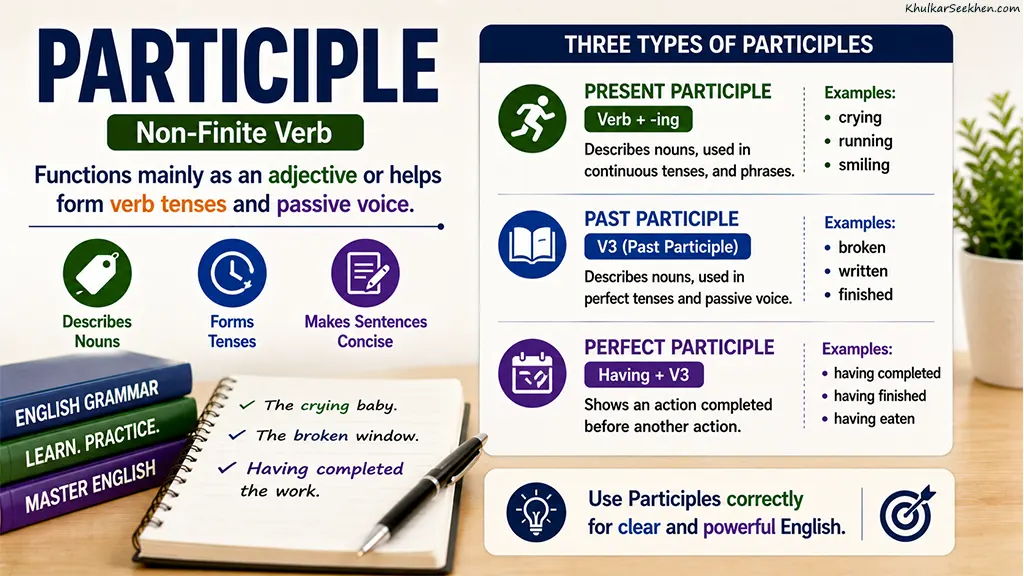
A Participle is one of the three types of Non-finite Verbs. Although it is formed from a verb, it mainly functions as an adjective or helps form different verb tenses.
Participles are widely used in describing nouns, forming continuous and perfect tenses, passive voice, and writing concise sentences.
In this lesson, you will learn:
- What is a Participle?
- Types of Participles
- Present Participle
- Past Participle
- Perfect Participle
- Participle vs Gerund
- Participle vs Infinitive
- Common mistakes
- Exercises with answers
What is a Participle?
Read the following sentences.
- The crying baby needs milk.
- The broken window has been repaired.
- Having completed the project, they celebrated.
The highlighted words are Participles.
Although they are formed from verbs, they are not the main verbs of these sentences.
Definition
A Participle is a non-finite verb that functions mainly as an adjective or helps in forming verb tenses and passive voice.
Types of Participles
There are three types of participles:
- Present Participle
- Past Participle
- Perfect Participle
1. Present Participle
A Present Participle is formed by adding -ing to the base form (V1) of a verb.
Structure:
Verb + ing
Examples:
- running
- smiling
- dancing
- playing
- writing
Uses of Present Participles:
A. As an Adjective
Examples:
- The crying child needs attention.
- A shining star appeared in the sky.
- The boiling water is very hot.
Here, the participles describe nouns.
B. In Continuous Tenses
Examples:
- She is reading a novel.
- They were playing football.
- We are learning English.
Here, the participles form part of the verb phrase.
C. In Participle Phrases
Examples:
- Walking along the road, I met my teacher.
- Smiling happily, she accepted the prize.
These phrases add extra information about the subject.
2. Past Participle
The Past Participle is the V3 form of a verb.
Examples:
- written
- broken
- finished
- eaten
- chosen
Uses of Past Participles:
A. As an Adjective
Examples:
- A broken chair.
- The fallen leaves covered the road.
- A written application.
B. In Perfect Tenses
Examples:
- I have finished my homework.
- She had left before sunset.
Here, the past participle combines with have/has/had.
C. In Passive Voice
Examples:
- The letter was written yesterday.
- The room has been cleaned.
3. Perfect Participle
The Perfect Participle is formed with: Having + Past Participle (V3)
Examples:
- having completed
- having finished
- having eaten
- having written
Uses of Perfect Participles:
A perfect participle shows that one action was completed before another action.
Examples:
- Having completed the assignment, she went to bed.
- Having finished the race, they celebrated.
- Having eaten dinner, we watched a movie.
Participle as an Adjective
Participles are commonly used before or after nouns.
Before the Noun:
- a smiling girl
- a broken chair
- a sleeping baby
After the Noun:
- The people waiting outside were tired.
- The books written by Premchand are famous.
Participle vs Gerund
Both participles and gerunds often end in -ing, but they have different functions.
| Gerund | Participle |
|---|---|
| Functions as a noun | Functions mainly as an adjective |
| Reading is enjoyable. | The reading boy is my friend. |
| Swimming is healthy. | The swimming child smiled. |
Compare:
Gerund
Reading improves knowledge.
(Reading is the subject.)
Present Participle
The reading student is intelligent.
(Reading describes student.)
Participle vs Infinitive
| Participle | Infinitive |
|---|---|
| smiling | to smile |
| broken | to break |
| Having completed | to complete |
Examples:
- The smiling child waved.
- I want to smile.
Dangling Participles
A dangling participle occurs when the participle phrase does not clearly describe the subject of the main clause.
Incorrect:
✘ Walking down the street, the flowers looked beautiful.
This wrongly suggests that the flowers were walking.
Correct:
✔ Walking down the street, I admired the beautiful flowers.
The subject of the participle phrase (I) is now clear.
Tip: The subject of a participle phrase should be the same as the subject of the main clause.
Common Mistakes
✘ The cry child.
✔ The crying child.
✘ Having finish the work, he went home.
✔ Having finished the work, he went home.
✘ Broken the glass, he ran away.
✔ Having broken the glass, he ran away.
✘ The written by Shakespeare play is famous.
✔ The play written by Shakespeare is famous.
✘ Reading the book, the television was on.
✔ Reading the book, I kept the television on mute.
Quick Revision Table
| Type | Structure | Example |
|---|---|---|
| Present Participle | Verb + ing | smiling |
| Past Participle | V3 | written |
| Perfect Participle | Having + V3 | Having completed |
Summary
- A Participle is a non-finite verb.
- Participles mainly function as adjectives or help form verb phrases.
- There are three types of participles:
- Present Participle
- Past Participle
- Perfect Participle
- Present participles are formed by adding -ing to the base verb.
- Past participles are the V3 forms of verbs.
- Perfect participles show that one action happened before another.
- Avoid dangling participles by ensuring the participle phrase clearly refers to the subject of the sentence.
Practice Exercise 1
Identify the participle and state its type.
- The crying baby needs milk.
- The broken window was repaired.
- Having completed the homework, she went outside.
- The smiling teacher welcomed the students.
- The letter written yesterday has arrived.
- We have finished the project.
- Having eaten lunch, they resumed work.
- The fallen leaves covered the ground.
- She is reading a novel.
- The boy standing near the gate is my cousin.
Practice Exercise 2
Choose the correct answer.
- Which of the following is a Present Participle?
- (a) written
- (b) writing
- (c) wrote
- (d) writes
- Which sentence contains a Past Participle used as an adjective?
- (a) The broken chair was repaired.
- (b) The boy is running.
- (c) Reading is enjoyable.
- (d) She wants to study.
- A Perfect Participle begins with:
- (a) To
- (b) Being
- (c) Having
- (d) Had
- Which sentence contains a dangling participle?
- (a) Walking to school, I met my friend.
- (b) Having completed the task, she rested.
- (c) Walking through the park, the flowers looked beautiful.
- (d) The smiling child waved.
- Which statement is correct?
- (a) A participle always functions as a noun.
- (b) A participle mainly functions as an adjective or as part of a verb phrase.
- (c) A participle is always preceded by to.
- (d) Every -ing word is a gerund.
Answers Exercise 1
- crying – Present Participle
- broken – Past Participle
- Having completed – Perfect Participle
- smiling – Present Participle
- written – Past Participle
- finished – Past Participle (used with have to form the Present Perfect tense)
- Having eaten – Perfect Participle
- fallen – Past Participle
- reading – Present Participle (part of the Present Continuous verb phrase)
- standing – Present Participle
Answers Exercise 2
- (b) writing
- (a) The broken chair was repaired.
- (c) Having
- (c) Walking through the park, the flowers looked beautiful.
- (b) A participle mainly functions as an adjective or as part of a verb phrase.
