Infinitive vs Gerund vs Participle: After learning Infinitives, Gerunds, and Participles separately, students often get confused because all three are Non-finite Verbs. Although they are formed from verbs, they perform different functions in a sentence.
This lesson compares all three forms side by side to help you understand when and how each one is used.
In this lesson, you will learn:
- What are Non-finite Verbs?
- Infinitive vs Gerund vs Participle
- Major differences
- Similarities
- Identification tricks
- Common mistakes
- Practice exercises with answers
What are Non-finite Verbs?
A Non-finite Verb is a verb that does not change according to the subject, person, number, or tense.
There are three types of non-finite verbs:
- Infinitive
- Gerund
- Participle
Unlike finite verbs, non-finite verbs cannot function as the main verb of an independent sentence.
Comparison at a Glance
| Feature | Infinitive | Gerund | Participle |
|---|---|---|---|
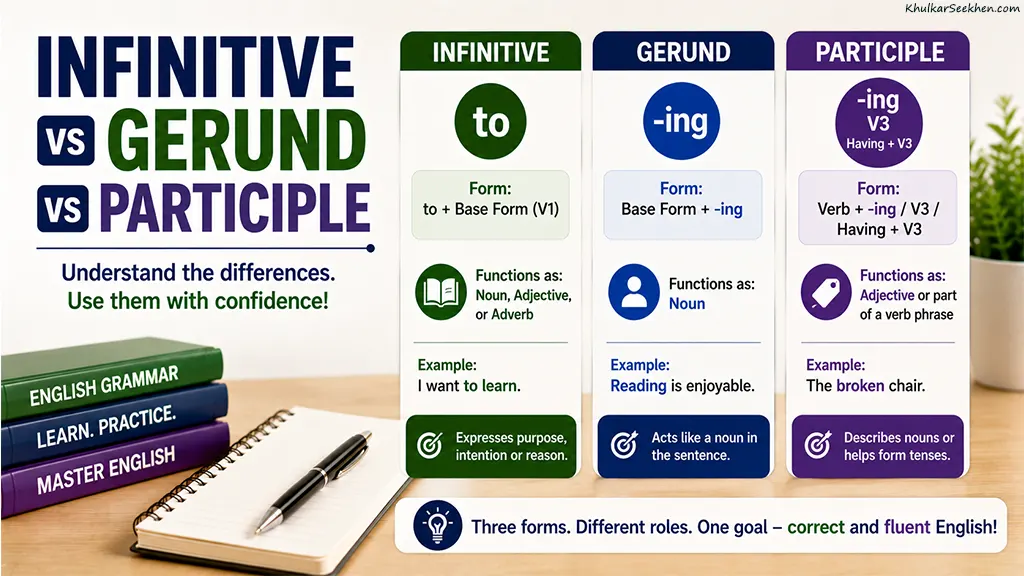
| Form | to + V1 (usually) | V1 + ing | V1 + ing, V3, or Having + V3 |
| Functions as | Noun, Adjective, Adverb | Noun | Adjective or part of a verb phrase |
| Changes with tense | ✘ | ✘ | ✘ |
| Main verb | ✘ | ✘ | ✘ |
| Example | to study | studying | studying, studied, having studied |
What is an Infinitive?
An Infinitive is usually formed by ‘to + base form (V1)’.
It can function as:
- a noun
- an adjective
- an adverb
Examples:
- I want to study.
- She has a book to read.
- He came to help us.
Uses of Infinitives
| Function | Example |
|---|---|
| Subject | To forgive is divine. |
| Object | I want to learn. |
| Adjective | I have work to finish. |
| Adverb (Purpose) | She came to help me. |
Read: more about Infinitives
What is a Gerund?
A Gerund is the ‘-ing’ form of a verb that functions as a noun.
Examples:
- Reading is enjoyable.
- I enjoy swimming.
- Walking keeps us healthy.
Uses of Gerunds
| Function | Example |
|---|---|
| Subject | Reading is useful. |
| Object | I enjoy reading. |
| After a preposition | She is interested in learning. |
| After certain verbs | He finished writing. |
Read: more about Gerunds
What is a Participle?
A Participle is a non-finite verb that mainly functions as an adjective or helps form verb tenses.
Examples:
- The crying child needs help.
- The broken chair was repaired.
- Having completed the work, he left.
Types of Participles
| Type | Structure | Example |
|---|---|---|
| Present Participle | Verb + ing | smiling |
| Past Participle | V3 | written |
| Perfect Participle | Having + V3 | Having finished |
Read: more about Participles
Difference Between Infinitive, Gerund and Participle
| Basis | Infinitive | Gerund | Participle |
|---|---|---|---|
| Form | to + V1 | Verb + ing | Verb + ing, V3, Having + V3 |
| Functions as | Noun, adjective, adverb | Noun | Adjective or part of a verb phrase |
| Used after modal verbs | Bare infinitive (V1) | ✘ | ✘ |
| Used after prepositions | Rare | ✔ | Sometimes in participle phrases |
| Describes a noun | Sometimes | ✘ | ✔ |
| Expresses purpose | ✔ | ✘ | ✘ |
| Forms continuous tenses | ✘ | ✘ | ✔ (Present Participle) |
| Forms perfect tenses | ✘ | ✘ | ✔ (Past Participle with have) |
Compare the Same Verb
Let’s use the verb read.
Infinitive
I want to read this book.
(Object of the verb “want”.)
Gerund
Reading books improves vocabulary.
(Subject of the sentence.)
Present Participle
The reading student is my cousin.
(Describes the noun “student”.)
Past Participle
The written application was accepted.
(Describes the noun “application”.)
Perfect Participle
Having read the instructions, she started the test.
(Shows that one action happened before another.)
How to Identify Them
Step 1
Does it begin with to + verb?
✔ Yes
→ Infinitive
Example
She wants to study.
Step 2
Does the -ing word work like a noun?
✔ Yes
→ Gerund
Example
Swimming is healthy.
Step 3
Does the word describe a noun?
✔ Yes
→ Participle
Example
The sleeping baby.
Step 4
Does it help form a tense?
✔ Yes
→ Participle
Example
She is reading.
Gerund vs Present Participle
This is one of the most confusing areas in English grammar.
| Gerund | Present Participle |
|---|---|
| Acts as a noun | Acts as an adjective or forms a verb phrase |
| Reading is enjoyable. | The reading boy smiled. |
| Swimming keeps us fit. | The swimming child waved. |
Infinitive vs Gerund
Some verbs are followed by infinitives, while others are followed by gerunds.
Verbs Followed by Infinitives
- decide
- hope
- agree
- promise
- plan
- refuse
- want
- wish
Examples:
- She decided to leave.
- I hope to meet you.
Verbs Followed by Gerunds
- enjoy
- avoid
- finish
- suggest
- keep
- consider
- practise
- imagine
Examples:
- She enjoys reading.
- We finished painting.
Verbs That Can Take Both
Some verbs can be followed by either a gerund or an infinitive.
Examples:
- begin
- start
- continue
- like
- love
- hate
Sentence Examples:
- He started working.
- He started to work.
In many cases, both forms are acceptable with little or no change in meaning.
Common Mistakes
✘ I enjoy to play football.
✔ I enjoy playing football.
✘ She can to swim.
✔ She can swim.
✘ He made me to laugh.
✔ He made me laugh.
✘ Reading the road, I found the answer.
✔ Reading the book, I found the answer.
✘ The running is healthy.
✔ Running is healthy.
Quick Revision Table
| Non-finite Verb | Main Function | Example |
|---|---|---|
| Infinitive | Noun, adjective, adverb | to read |
| Gerund | Noun | reading |
| Present Participle | Adjective, continuous tense | reading |
| Past Participle | Adjective, perfect/passive forms | written |
| Perfect Participle | Earlier completed action | Having written |
Memory Tips:
Use an Infinitive when:
- expressing purpose
- after many verbs like want, decide, hope, promise
- after modal verbs (use the bare infinitive)
Example:
- I want to study.
- She can drive.
Use a Gerund when:
- the verb acts as a noun
- after prepositions
- after verbs like enjoy, avoid, and finish
Example:
- Reading is enjoyable.
- She is interested in learning.
Use a Participle when:
- describing a noun
- forming continuous or perfect tenses
- writing participle phrases
Example:
- The smiling child.
- She is reading.
- Having finished the work, he left.
Summary
- Infinitives, Gerunds, and Participles are all Non-finite Verbs.
- An Infinitive usually begins with to and can function as a noun, adjective, or adverb.
- A Gerund is the -ing form of a verb that functions as a noun.
- A Participle mainly functions as an adjective or forms part of a verb phrase.
- Identifying the function of the word in the sentence is the easiest way to distinguish between them.
Practice Exercise 1
Identify whether the highlighted word is an Infinitive, Gerund, or Participle.
- Reading books improves knowledge.
- I want to learn English.
- The broken chair was repaired.
- She enjoys dancing.
- The smiling child greeted everyone.
- Having completed the homework, he went outside.
- We came to help you.
- Swimming is my favourite hobby.
- The written report was submitted yesterday.
- They decided to travel by train.
Practice Exercise 2
Choose the correct answer.
- Which non-finite verb functions mainly as a noun?
- (a) Participle
- (b) Gerund
- (c) Infinitive
- (d) Auxiliary
- Which sentence contains an infinitive?
- (a) Reading is useful.
- (b) The crying child is hungry.
- (c) I want to study.
- (d) She is studying.
- Which sentence contains a participle used as an adjective?
- (a) Running is healthy.
- (b) I enjoy running.
- (c) The running boy won the race.
- (d) They started running.
- Which sentence is correct?
- (a) She enjoys to swim.
- (b) She enjoys swimming.
- (c) She enjoys swim.
- (d) She enjoys to swimming.
- Which sentence contains a perfect participle?
- (a) Having completed the work, he left.
- (b) The crying baby slept.
- (c) To read is useful.
- (d) Reading is enjoyable.
Answers Exercise 1
- Reading – Gerund
- to learn – Infinitive
- broken – Past Participle
- dancing – Gerund
- smiling – Present Participle
- Having completed – Perfect Participle
- to help – Infinitive
- Swimming – Gerund
- written – Past Participle
- to travel – Infinitive
Answers Exercise 2
- (b) Gerund
- (c) I want to study.
- (c) The running boy won the race.
- (b) She enjoys swimming.
- (a) Having completed the work, he left.
