An Adverb is one of the eight parts of speech. It adds more information about a verb, adjective, another adverb, or even an entire sentence. Adverbs tell us how, when, where, how often, or to what extent something happens.
Without adverbs, sentences often become less clear and less expressive.
In this lesson, you will learn:
- What is an Adverb?
- Functions of Adverbs
- Types of Adverbs
- Formation of Adverbs
- Position of Adverbs
- Relative and Interrogative Adverbs
- Common mistakes
- Exercises with answers
What is an Adverb?
Read the following sentences.
- Veer Abdul Hamid fought bravely.
- Maria’s dress is extremely beautiful.
- We worked very carefully.
- Kabir was badly injured.
The highlighted words add more information.
- bravely modifies the verb fought
- extremely modifies the adjective beautiful
- very modifies the adverb carefully
- badly modifies the adjective injured
These words are Adverbs.
Definition
An Adverb is a word that modifies a verb, an adjective, another adverb, or sometimes an entire sentence.
What Does an Adverb Modify?
An adverb may modify:
| Modifies | Example |
|---|---|
| Verb | She spoke softly. |
| Adjective | It is extremely cold. |
| Another adverb | He ran very quickly. |
| Entire sentence | Fortunately, nobody was hurt. |
Functions of Adverbs
Adverbs answer questions such as:
- How?
- When?
- Where?
- How often?
- To what extent?
- Why? (occasionally)
Types of Adverbs
The most common types of adverbs are:
- Adverbs of Manner
- Adverbs of Time
- Adverbs of Place
- Adverbs of Frequency
- Adverbs of Degree
- Relative Adverbs
- Interrogative Adverbs
1. Adverb of Manner
An Adverb of Manner tells us how an action is performed.
Question Answered: How?
Examples
- The child slept soundly.
- Kavya cried loudly.
- Kapil plays fearlessly.
- She performed well.
Common Adverbs of Manner
- carefully
- beautifully
- bravely
- slowly
- quickly
- seriously
- loudly
- softly
- well
- fast
Formation of Adverbs of Manner
Many adverbs of manner are formed by adding -ly to adjectives.
| Adjective | Adverb |
|---|---|
| careful | carefully |
| brave | bravely |
| quick | quickly |
| happy | happily |
| polite | politely |
Exceptions
Some adverbs do not end in -ly.
Examples
- fast
- hard
- late
- well
2. Adverb of Time
An Adverb of Time tells us when an action happens.
Question Answered: When?
Examples
- Sarita hurt her knee yesterday.
- Gulliver soon became friendly with the Lilliputians.
- Lions slept every night.
- Pragya always follows traffic rules.
Common Adverbs of Time
today, yesterday, tomorrow, now, then, later, early, recently, soon
3. Adverb of Place
An Adverb of Place tells us where an action happens.
Question Answered: Where?
Examples
- The lamb followed Mary everywhere.
- My grandfather lives nearby.
- Sit there.
- The boys played outside.
Common Adverbs of Place
here, there, nearby, outside, inside, everywhere, upstairs, downstairs, abroad
4. Adverb of Frequency
An Adverb of Frequency tells us how often an action happens.
Question Answered: How often?
Examples
- Mukesh visited his sister twice.
- Saniya is usually satisfied.
- We always follow traffic rules.
- Sudha often makes mistakes.
Common Adverbs of Frequency
always, never, often, usually, frequently, occasionally, seldom, once, twice, daily
5. Adverb of Degree
An Adverb of Degree tells us how much or to what extent something happens.
It may modify a verb, adjective, or another adverb.
Examples
- Shantanu was totally puzzled.
- We thoroughly enjoyed the picnic.
- Rana has almost finished dinner.
- She is very beautiful.
- I am fully prepared.
Common Adverbs of Degree
very, quite, almost, nearly, completely, fully, hardly, extremely, absolutely, slightly
6. Relative Adverbs
Relative adverbs introduce relative clauses and also modify the verb within those clauses.
The most common relative adverbs are:
- when
- where
- why
- how
Examples
- This is the field where I play.
- I do not know when he will return.
- We do not know why he left.
- This is how I solved the problem.
Functions
| Relative Adverb | Refers To |
|---|---|
| when | Time |
| where | Place |
| why | Reason |
| how | Manner |
7. Interrogative Adverbs
Interrogative adverbs are used to ask questions.
The most common interrogative adverbs are:
- why
- when
- where
- how
Examples
- Why are you laughing?
- How is your mother now?
- Where do you live?
- When will the train arrive?
These words modify the verb while introducing a question.
Position of Adverbs
The position of an adverb depends on its type.
| Type | Common Position | Example |
|---|---|---|
| Manner | After the verb/object | She sang beautifully. |
| Time | Beginning or end | We met yesterday. |
| Place | Usually after the verb | He waited outside. |
| Frequency | Before the main verb | She always smiles. |
| Degree | Before the adjective/adverb | Very beautiful |
Comparison of Different Types of Adverbs
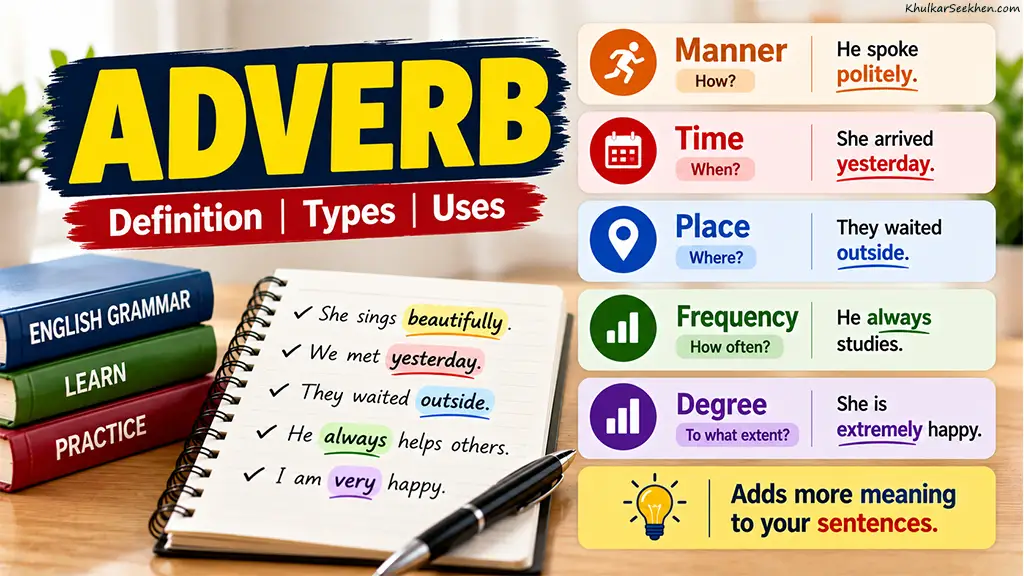
| Type | Question | Example |
|---|---|---|
| Manner | How? | He spoke politely. |
| Time | When? | She arrived yesterday. |
| Place | Where? | They waited outside. |
| Frequency | How often? | He always studies. |
| Degree | How much? | She is extremely happy. |
| Relative | Joins a clause | This is the place where I live. |
| Interrogative | Asks a question | Where do you live? |
Common Mistakes
✘ She sings beautiful.
✔ She sings beautifully.
✘ He speaks very slow.
✔ He speaks very slowly.
✘ I am enough strong.
✔ I am strong enough.
✘ He drives careful.
✔ He drives carefully.
✘ She hardly worked very hard.
✔ She worked very hard.
(Hardly means “almost not,” so it should not be confused with hard.)
Quick Revision Table
| Type | Question | Example |
|---|---|---|
| Manner | How? | carefully |
| Time | When? | yesterday |
| Place | Where? | here |
| Frequency | How often? | always |
| Degree | To what extent? | very |
| Relative | Connects clauses | where |
| Interrogative | Asks questions | why |
Summary
- An Adverb modifies a verb, adjective, another adverb, or an entire sentence.
- The five main semantic types are Manner, Time, Place, Frequency, and Degree.
- Relative and Interrogative Adverbs are classified based on their grammatical function.
- Many adverbs are formed by adding -ly to adjectives, though there are important exceptions.
- The position of an adverb depends on its type and the meaning of the sentence.
Practice Exercise 1
Identify the adverb and state its type.
- God is everywhere.
- I told him this already.
- The children read the lesson silently.
- Traffic is usually heavy during the Kumbh Mela in Prayagraj.
- Why is Dr. A. P. J. Abdul Kalam known as the “Missile Man of India”?
- Santosh Yadav climbed Mount Everest twice.
- This is the reason why I never talk to him.
- It has been raining since morning.
- How did she pay her school fees?
- He was very happy when his daughter won first prize.
Practice Exercise 2
Choose the correct answer.
- Which adverb answers the question “How?”
- (a) Adverb of Time
- (b) Adverb of Manner
- (c) Adverb of Place
- (d) Adverb of Frequency
- Which sentence contains an Adverb of Degree?
- (a) She arrived yesterday.
- (b) He works carefully.
- (c) They are extremely happy.
- (d) We met outside.
- Which word is an Interrogative Adverb?
- (a) quickly
- (b) yesterday
- (c) where
- (d) always
- Which sentence contains a Relative Adverb?
- (a) Where do you live?
- (b) This is the place where I was born.
- (c) Sit here.
- (d) He always helps others.
- Which sentence is correct?
- (a) She sings beautiful.
- (b) She sings beautifully.
- (c) She beautifully is singing.
- (d) She singing beautifully.
Answers Exercise 1
- everywhere – Adverb of Place
- already – Adverb of Time
- silently – Adverb of Manner
- usually – Adverb of Frequency
- Why – Interrogative Adverb
- twice – Adverb of Frequency
- why – Relative Adverb
- since morning – Adverbial phrase of Time
- How – Interrogative Adverb
- very – Adverb of Degree
Answers Exercise 2
- (b) Adverb of Manner
- (c) They are extremely happy.
- (c) where
- (b) This is the place where I was born.
- (b) She sings beautifully.
