In English grammar, gender refers to the classification of nouns based on whether they represent a male, a female, both, or neither.
Understanding gender helps us use the correct nouns and pronouns while speaking and writing.
What is Gender?
Read the following words:
- boy
- girl
- doctor
- book
Each word gives us different information about gender.
- Boy refers to a male.
- Girl refers to a female.
- Doctor may refer to either a male or a female.
- Book is neither male nor female.
Based on gender, nouns are traditionally divided into four types.
Types of Gender
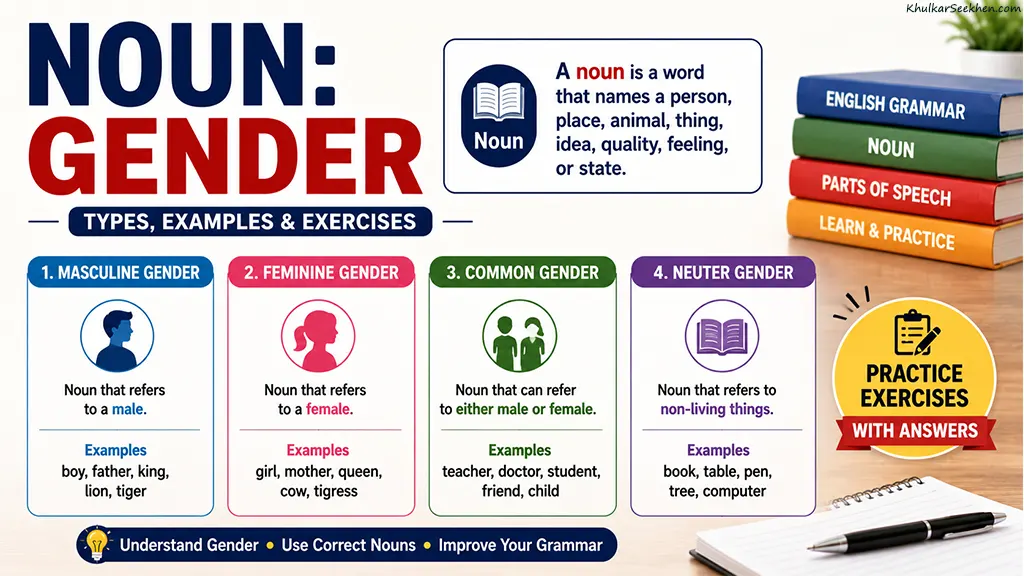
There are four types of gender in English grammar:
- Masculine Gender
- Feminine Gender
- Common Gender
- Neuter Gender
Let’s learn each type in detail.
1. Masculine Gender
A noun that refers to a male person or male animal is called Masculine Gender.
Definition
A noun that denotes a male person or male animal is called Masculine Gender.
Examples
- boy
- man
- father
- brother
- king
- prince
- husband
- uncle
- bull
- horse
- tiger
- peacock
2. Feminine Gender
A noun that refers to a female person or female animal is called Feminine Gender.
Definition
A noun that denotes a female person or female animal is called Feminine Gender.
Examples
- girl
- woman
- mother
- sister
- queen
- princess
- wife
- aunt
- cow
- mare
- tigress
- peahen
3. Common Gender
Some nouns can refer to either a male or a female. Such nouns are called Common Gender nouns.
Definition
A noun that can denote either a male or a female is called Common Gender.
Examples
- student
- teacher
- doctor
- engineer
- friend
- child
- parent
- neighbour
- player
- leader
Note: Most professions in modern English use common-gender nouns. For example, we usually say doctor, teacher, engineer, or actor for both men and women.
4. Neuter Gender
A noun that refers to non-living things or things that are neither male nor female is called Neuter Gender.
Definition
A noun that denotes a non-living thing or something that has no gender is called Neuter Gender.
Examples
- book
- chair
- table
- pen
- room
- tree
- computer
- mobile
- school
- river
Note: Most non-living things belong to the Neuter Gender.
Examples of Masculine and Feminine Gender
| Masculine | Feminine |
|---|---|
| Father | Mother |
| Brother | Sister |
| Husband | Wife |
| King | Queen |
| Prince | Princess |
| Uncle | Aunt |
| Nephew | Niece |
| Grandfather | Grandmother |
| Bull | Cow |
| Horse | Mare |
| Peacock | Peahen |
| Tiger | Tigress |
| Lion | Lioness |
| Hero | Heroine |
Formation of Feminine Gender
Many masculine nouns are changed into feminine nouns in different ways.
1. By Changing the Word Completely
| Masculine | Feminine |
|---|---|
| Father | Mother |
| Brother | Sister |
| Husband | Wife |
| King | Queen |
| Uncle | Aunt |
| Nephew | Niece |
| Bull | Cow |
| Horse | Mare |
2. By Adding -ess
Many feminine nouns are formed by adding -ess to the masculine noun.
| Masculine | Feminine |
|---|---|
| Lion | Lioness |
| Host | Hostess |
| Steward | Stewardess* |
| Waiter | Waitress |
| Poet | Poetess* |
Note: In modern English, words such as host, poet, and steward are often used for both men and women. However, forms like hostess, poetess, and stewardess may still appear in traditional grammar books and school examinations.
3. By Adding -ine
Some nouns form the feminine by adding -ine.
| Masculine | Feminine |
|---|---|
| Hero | Heroine |
4. By Changing the Ending
Some words change their spelling.
| Masculine | Feminine |
|---|---|
| Actor | Actress* |
| Prince | Princess |
| Emperor | Empress |
Modern Usage: Today, actor is commonly used for both men and women, although actress is still accepted and may appear in textbooks and exams.
Common Gender vs Neuter Gender
| Common Gender | Neuter Gender |
|---|---|
| Refers to either a male or a female | Refers to non-living things |
| doctor | book |
| student | chair |
| teacher | computer |
| friend | table |
| child | mobile |
Quick Summary
| Gender | Meaning | Examples |
|---|---|---|
| Masculine | Male person or animal | king, father, tiger |
| Feminine | Female person or animal | queen, mother, tigress |
| Common | Can refer to both males and females | teacher, student, doctor |
| Neuter | Non-living thing or object | book, pen, chair |
Important Points to Remember
- English grammar traditionally has four genders.
- Proper nouns also have gender. For example, Rahul is masculine, while Sita is feminine.
- Most profession names today are common gender (teacher, doctor, engineer, pilot).
- Most non-living things belong to the Neuter Gender.
- Some traditional feminine forms (such as actress, poetess, and stewardess) are still taught in schools, but modern English increasingly uses gender-neutral terms.
Practice Exercise 1
Identify the gender of the highlighted noun.
- My brother is a doctor.
- The queen addressed the people.
- Our teacher explained the lesson.
- The table is made of wood.
- The lioness protected her cubs.
- Every student must complete the assignment.
- The peacock spread its feathers.
- This computer is very fast.
- My mother cooks delicious food.
- The child is sleeping peacefully.
Practice Exercise 2
Write the feminine form of the following masculine nouns.
- King
- Prince
- Lion
- Uncle
- Father
- Hero
- Nephew
- Bull
- Peacock
- Husband
Exercise 1 Answers
- Brother → Masculine Gender
- Queen → Feminine Gender
- Teacher → Common Gender
- Table → Neuter Gender
- Lioness → Feminine Gender
- Student → Common Gender
- Peacock → Masculine Gender
- Computer → Neuter Gender
- Mother → Feminine Gender
- Child → Common Gender
Exercise 2 Answers
- Queen
- Princess
- Lioness
- Aunt
- Mother
- Heroine
- Niece
- Cow
- Peahen
- Wife
