Every noun tells us whether it refers to one person or thing or more than one. This difference is called Number.
Understanding singular and plural nouns, as well as countable and uncountable nouns, helps us use the correct verbs, pronouns, and sentence structure.
What is Number?
Read the following pairs of words.
| Singular | Plural |
|---|---|
| boy | boys |
| book | books |
| man | men |
| ox | oxen |
In each pair:
- The first word refers to one person, animal, or thing.
- The second word refers to more than one.
This difference is known as Number.
Definition
Number is the grammatical form of a noun that tells whether it refers to one person, animal, place, or thing, or to more than one.
Types of Number
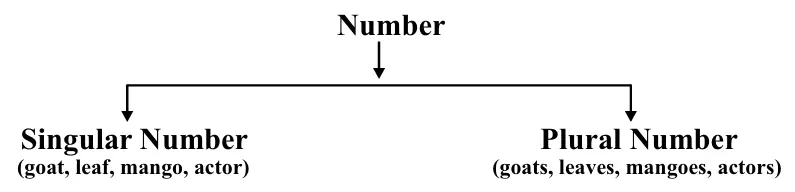
There are two types of Number:
- Singular Number
- Plural Number
1. Singular Number
A noun that refers to one person, animal, place, or thing is called a Singular Noun.
Examples:
- boy
- doctor
- cow
- dog
- pen
- bag
- mango
- actor
2. Plural Number
A noun that refers to more than one person, animal, place, or thing is called a Plural Noun.
Examples:
- boys
- doctors
- cows
- dogs
- bags
- mangoes
- actors
Note: Only countable nouns can usually be changed from singular to plural.
Rules for Forming Plural Nouns
English nouns form their plurals in different ways.
Rule 1: Add -s to Most Nouns
Most nouns form the plural by adding -s.
| Singular | Plural |
|---|---|
| table | tables |
| chair | chairs |
| plant | plants |
| finger | fingers |
| clock | clocks |
Rule 2: Add -es to Nouns Ending in -s, -ss, -sh, -ch, -x, or -z
Nouns ending in -s, -ss, -sh, -ch, -x, or -z usually take -es.
| Singular | Plural |
|---|---|
| class | classes |
| brush | brushes |
| watch | watches |
| branch | branches |
| box | boxes |
| quiz | quizzes |
Rule 3: Nouns Ending in -o
Many nouns ending in -o form the plural by adding -es.
| Singular | Plural |
|---|---|
| hero | heroes |
| potato | potatoes |
| tomato | tomatoes |
| buffalo | buffaloes |
| mango | mangoes |
Exception:
Some nouns ending in -o simply take -s.
- photo → photos
- piano → pianos
- radio → radios
- video → videos
Tip: There is no single rule for all nouns ending in -o, so some words must be memorized.
Rule 4: Nouns Ending in a Consonant + -y
If a noun ends in a consonant followed by y, change y to i and add -es.
| Singular | Plural |
|---|---|
| baby | babies |
| city | cities |
| lady | ladies |
| story | stories |
| army | armies |
Rule 5: Nouns Ending in a Vowel + -y
If y is preceded by a vowel (a, e, i, o, u), simply add -s.
| Singular | Plural |
|---|---|
| boy | boys |
| toy | toys |
| monkey | monkeys |
| key | keys |
| day | days |
Rule 6: Nouns Ending in -f or -fe
Many nouns ending in -f or -fe change f/fe to -ves.
| Singular | Plural |
|---|---|
| knife | knives |
| life | lives |
| thief | thieves |
| shelf | shelves |
| calf | calves |
| half | halves |
Exceptions:
Some nouns simply add -s.
- roof → roofs
- chief → chiefs
- belief → beliefs
- cliff → cliffs
Rule 7: Change the Internal Vowel
Some nouns change their spelling completely.
| Singular | Plural |
|---|---|
| man | men |
| woman | women |
| foot | feet |
| tooth | teeth |
| goose | geese |
| mouse | mice |
Rule 8: Add -en or Other Irregular Forms
A few nouns form the plural by adding -en.
| Singular | Plural |
|---|---|
| child | children |
| ox | oxen |
Rule 9: Compound Nouns
In compound nouns, the main noun usually takes the plural form.
| Singular | Plural |
|---|---|
| brother-in-law | brothers-in-law |
| mother-in-law | mothers-in-law |
| passer-by | passers-by |
| commander-in-chief | commanders-in-chief |
| governor-general | governors-general |
Rule 10: Same Singular and Plural Forms
Some nouns have the same form in both singular and plural.
| Singular | Plural |
|---|---|
| sheep | sheep |
| deer | deer |
| aircraft | aircraft |
| series | series |
| species | species |
Note: Words like fish and fruit usually remain unchanged in general use (two fish, some fruit), but fishes and fruits are also correct in specific contexts (for example, different species of fish or different kinds of fruit).
- fish → fish (general), fishes (different species)
- fruit → fruit (general), fruits (different kinds of fruit)
- hair → hair (collectively), hairs (individual strands)
Rule 11: Nouns Always Used in the Plural
Some nouns are always treated as plural.
Examples:
- scissors
- trousers
- jeans
- pants
- spectacles
- tongs
- binoculars
- shorts
We say:
✔ My scissors are sharp.
❌ My scissors is sharp.
Rule 12: Nouns That Look Plural but Are Singular
Some nouns end in -s but are singular in meaning.
Examples:
- mathematics
- physics
- economics
- news
- measles
- billiards
We say:
✔ Mathematics is my favourite subject.
✔ The news is interesting.
Summary of Plural Formation Rules
| Rule | Example |
|---|---|
| Add -s | book → books |
| Add -es | box → boxes |
| -o → -es (many words) | hero → heroes |
| -o → -s (some words) | photo → photos |
| -y → -ies | city → cities |
| Vowel + y → +s | boy → boys |
| -f/-fe → -ves | knife → knives |
| Change vowel | man → men |
| Irregular | child → children |
| Same form | sheep → sheep |
Important Points to Remember
- Only countable nouns usually have singular and plural forms.
- Most nouns form the plural by adding -s.
- English has many irregular plural nouns, so they should be memorized.
- Some nouns are always plural, while others look plural but are grammatically singular.
- Always make sure the verb agrees with the number of the noun.
Countable and Uncountable Nouns
Nouns can also be classified according to whether they can be counted or not counted.
What are Countable and Uncountable Nouns?
Look at the following nouns:
- knife
- house
- dress
- milk
- petrol
- dust
We can easily count knife, house, and dress.
For example:
- one knife
- two knives
- three knives
However, we cannot count milk, petrol, or dust directly.
Instead, we measure them using units such as litres, kilograms, bottles, or cups.
Based on this, nouns are divided into two types:
- Countable Nouns
- Uncountable Nouns
1. Countable Nouns
Countable nouns are nouns that can be counted. They have both singular and plural forms.
Definition
A Countable Noun is a noun that can be counted as one, two, three, or more.
Examples
- book
- pen
- apple
- student
- house
- chair
- photo
- tomato
- cow
Examples in sentences:
- I have one book.
- She bought three apples.
- There are many students in the classroom.
2. Uncountable Nouns
Uncountable nouns are nouns that cannot be counted individually. These nouns usually do not have plural forms.
They usually refer to substances, materials, liquids, gases, ideas, feelings, or qualities.
Definition
An Uncountable Noun is a noun that cannot be counted individually and is usually measured in units or quantities.
Examples
- water
- milk
- sugar
- rice
- gold
- silver
- petrol
- air
- dust
- furniture
- luggage
- information
- advice
Examples in sentences:
- Please give me some water.
- Sugar is sweet.
- Gold is a precious metal.
Measuring Uncountable Nouns
Since uncountable nouns cannot be counted directly, we use units of measurement.
Examples:
| Uncountable Noun | Measurement |
|---|---|
| milk | two litres of milk |
| sugar | five kilograms of sugar |
| tea | two cups of tea |
| bread | three loaves of bread |
| rice | a bag of rice |
| water | a bottle of water |
| petrol | five litres of petrol |
| paper | a sheet of paper |
Rules for Using Countable and Uncountable Nouns
Rule 1: Uncountable Nouns Usually Have No Plural Form
Uncountable nouns are generally used only in the singular form.
Incorrect:
❌ We will have rices for lunch.
❌ I drink plenty of milks.
❌ Ritu has long hairs.
❌ There was a lot of dirts in the room.
Correct:
✔ We will have rice for lunch.
✔ I drink plenty of milk.
✔ Ritu has long hair.
✔ There was a lot of dirt in the room.
Note: Some uncountable nouns, such as hair, fruit, and fish, have special uses where plural forms are possible in certain contexts. However, in general school grammar, they are treated as uncountable.
Rule 2: Do Not Use a or an Before Uncountable Nouns
Since uncountable nouns cannot be counted individually, they normally do not take the articles a or an.
Incorrect:
❌ The ring is made of a gold.
❌ Give me a water.
❌ I need an advice.
Correct:
✔ The ring is made of gold.
✔ Give me some water.
✔ I need some advice.
Note: In everyday English, expressions like “a coffee” or “a tea” are common when referring to a cup of coffee or a cup of tea. However, for school grammar, follow the standard rule unless the context clearly refers to a serving.
Rule 3: Use Quantity Expressions
Uncountable nouns are measured using suitable units.
Examples:
- two litres of milk
- five kilograms of sugar
- three bottles of water
- four cups of tea
- two loaves of bread
- a piece of advice
- a bar of chocolate
Rule 4: Use Many with Countable Nouns and Much with Uncountable Nouns
Countable Nouns:
- I have many books.
- She has many friends.
- How many students are present?
Uncountable Nouns:
- Too much sugar is unhealthy.
- We do not have much time.
- How much money do you have?
Rule 5: Use Few and Little Correctly
| Countable Nouns | Uncountable Nouns |
|---|---|
| few | little |
| a few | a little |
Examples:
Countable
- We stayed in Paris for a few days.
- He has few friends.
Uncountable
- I can speak a little English.
- There is little milk in the bottle.
- Please give me a little discount.
Remember:
- Few / A few → Countable nouns
- Little / A little → Uncountable nouns
Quick Comparison
| Countable Nouns | Uncountable Nouns |
|---|---|
| Can be counted | Cannot be counted directly |
| Have singular and plural forms | Usually have only one form |
| Can use a/an | Normally, do not use a/an |
| Use many, few | Use much, little |
| Example: books | Example: milk |
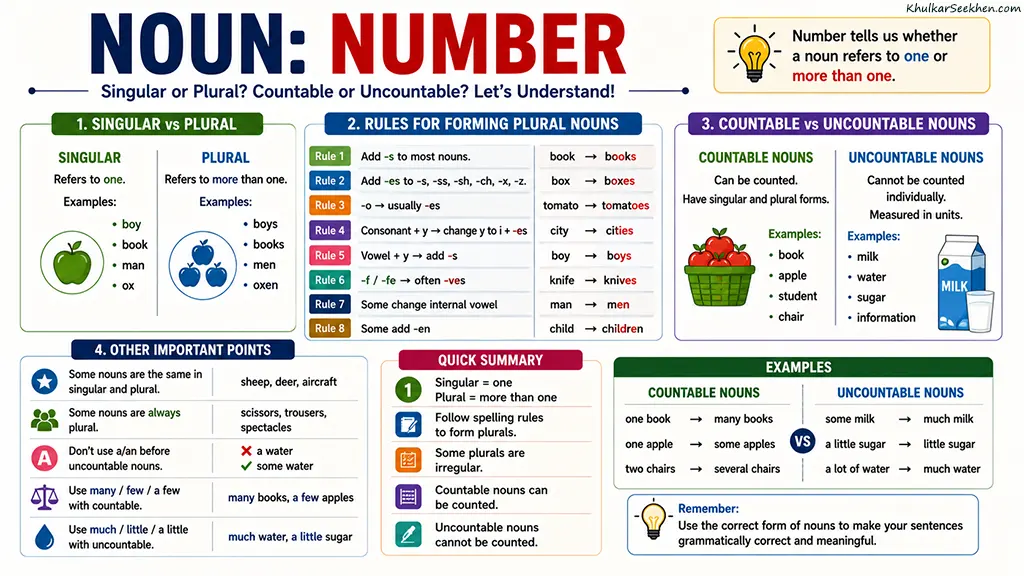
Summary
- Number tells whether a noun is singular or plural.
- English nouns form plurals using different spelling rules.
- Some nouns have irregular plural forms.
- Some nouns have the same singular and plural forms.
- Some nouns are always plural, while others look plural but are singular.
- Countable nouns can be counted and have singular and plural forms.
- Uncountable nouns cannot be counted individually and are usually measured using units or quantities.
- Do not normally use a/an before uncountable nouns.
- Use many, few, and a few with countable nouns.
- Use much, little, and a little with uncountable nouns.
Practice Set 1
Exercise 1
Write the plural forms of the following nouns.
- Child
- City
- Knife
- Hero
- Fox
- Potato
- Woman
- Sheep
- Brother-in-law
- Photo
Exercise 2
Identify whether the highlighted noun is Countable or Uncountable.
- Please give me some water.
- I bought three books.
- She needs more information.
- There are many students in the classroom.
- We need a little sugar.
- He has two cars.
- The furniture is new.
- We planted five trees.
- I need some advice.
- There are several chairs in the hall.
Exercise 1 Answers
- Children
- Cities
- Knives
- Heroes
- Foxes
- Potatoes
- Women
- Sheep
- Brothers-in-law
- Photos
Exercise 2 Answers
- Water → Uncountable
- Books → Countable
- Information → Uncountable
- Students → Countable
- Sugar → Uncountable
- Cars → Countable
- Furniture → Uncountable
- Trees → Countable
- Advice → Uncountable
- Chairs → Countable
Practice Set 2
Exercise 1
Write the plural form of the following nouns.
- Book
- Brush
- City
- Boy
- Knife
- Hero
- Child
- Deer
- Mouse
- Photo
Exercise 2
Choose the correct form to complete each sentence.
- The (boy/boys) are playing in the park.
- I bought two (knife/knives).
- There are many (city/cities) in India.
- The (news/newses) is interesting.
- Three (deer/deers) were seen in the forest.
- My (trouser/trousers) are too long.
- Two (photo/photos) were missing.
- The (child/children) are singing.
- These (box/boxes) are heavy.
- Five (mouse/mice) were caught.
Exercise 1 Answers
- Books
- Brushes
- Cities
- Boys
- Knives
- Heroes
- Children
- Deer
- Mice
- Photos
Exercise 2 Answers
- boys
- knives
- cities
- news
- deer
- trousers
- photos
- children
- boxes
- mice
Practice Set 3
Exercise 1
Identify whether the underlined noun is Countable or Uncountable.
- Please give me some water.
- I have three pens.
- She bought a new dress.
- We need more information.
- There are many students in the class.
- My mother bought some rice.
- The books are on the table.
- We don’t have much time.
- He gave me useful advice.
- There are five chairs in the room.
Exercise 2
Choose the correct word.
- I have (many/much) books.
- There isn’t (many/much) milk left.
- She has (few/little) friends in the city.
- We have (a few/a little) sugar.
- There are (many/much) cars on the road.
- Please give me (a few/a little) water.
- How (many/much) students are absent today?
- How (many/much) money do you have?
- We bought two (pieces/piece) of furniture.
- There is (a few/a little) hope left.
Exercise 1 Answers
- Water → Uncountable
- Pens → Countable
- Dress → Countable
- Information → Uncountable
- Students → Countable
- Rice → Uncountable
- Books → Countable
- Time → Uncountable
- Advice → Uncountable
- Chairs → Countable
Exercise 2 Answers
- many
- much
- few
- a little
- many
- a little
- many
- much
- pieces
- a little
