A noun does not work alone in a sentence. It has a relationship with the verb and other words in the sentence. This relationship is called its case.
Understanding the case of a noun helps us identify its role in a sentence, such as whether it is the subject, object, owner, receiver, or person being addressed.
What is Case?
Read the following sentences.
- Sachin bought a car.
- She goes to school.
In the first sentence:
- Sachin is the person who performs the action.
- Car is the thing affected by the action.
In the second sentence:
- She performs the action.
- School tells us where she goes.
Each noun or pronoun has a different relationship with the verb.
Definition
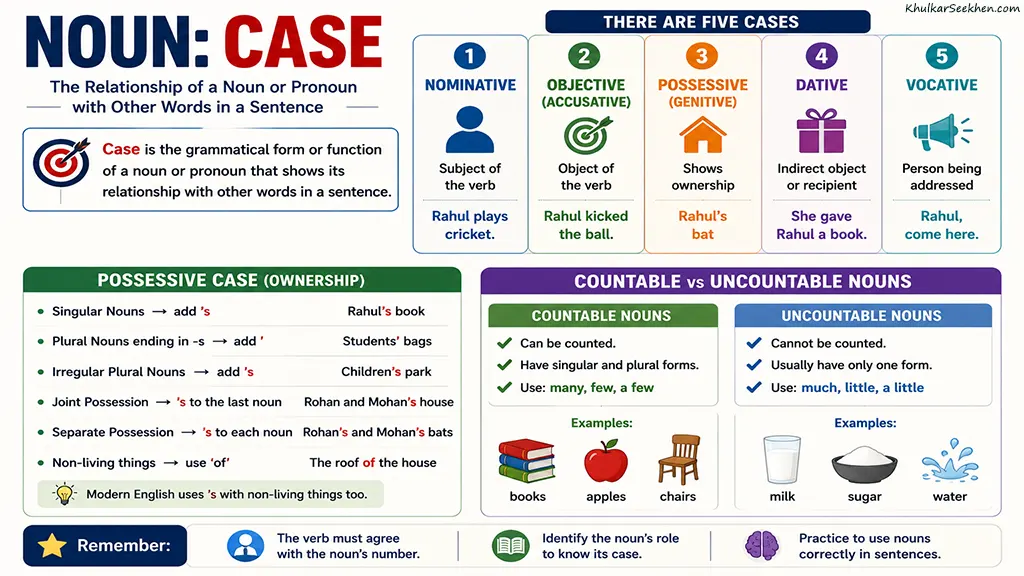
Case is the grammatical form or function of a noun or pronoun that shows its relationship with other words, especially the verb, in a sentence.
Types of Cases
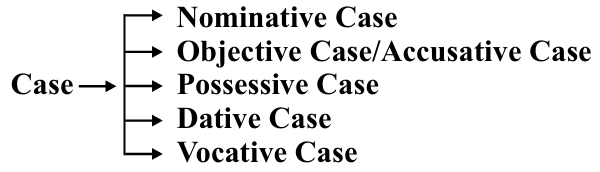
In traditional English grammar, there are five cases.
- Nominative Case
- Objective (Accusative) Case
- Possessive (Genitive) Case
- Dative Case
- Vocative Case
1. Nominative Case
A noun or pronoun used as the subject of a verb is said to be in the Nominative Case.
Definition
When a noun or pronoun performs the action of the verb or is the subject of the sentence, it is in the Nominative Case.
Examples
- Kiran has many toys.
- They are singing.
- The shirt is black.
- My father works in a bank.
In these sentences, Kiran, They, The shirt, and My father are the subjects.
How to Identify the Nominative Case
Ask Who? or What? before the verb.
| Question | Answer |
|---|---|
| Who has many toys? | Kiran |
| Who are singing? | They |
| What is black? | The shirt |
2. Objective (Accusative) Case
A noun or pronoun used as the object of a verb is said to be in the Objective (Accusative) Case.
Definition
When a noun or pronoun receives the action of a verb, it is in the Objective (Accusative) Case.
Examples
- The girl ate a chocolate.
- Sarita watched the movie.
- The President met us.
- Rahul kicked the ball.
The words chocolate, movie, us, and ball are the objects of the verbs.
How to Identify the Objective Case
Ask What? or Whom? after the verb.
| Question | Answer |
|---|---|
| What did the girl eat? | Chocolate |
| What did Sarita watch? | The movie |
| Whom did the President meet? | Us |
3. Possessive (Genitive) Case
The Possessive Case shows ownership, possession, or a close relationship between two nouns.
Definition
When a noun shows ownership or possession, it is said to be in the Possessive (Genitive) Case.
Examples
- Abdul’s pencil
- The teacher’s bag
- Riya’s notebook
Here, the nouns Abdul, teacher, and Riya show ownership.
Rules for Forming the Possessive Case
Rule 1: Singular Nouns
Add ‘s to a singular noun.
| Singular Noun | Possessive Form |
|---|---|
| Rahul | Rahul’s |
| Queen | Queen’s |
| Teacher | Teacher’s |
Examples:
- Rahul’s bicycle is new.
- The Queen’s crown was made of gold.
Rule 2: Regular Plural Nouns Ending in -s
Add only an apostrophe (‘).
| Plural Noun | Possessive Form |
|---|---|
| students | students’ |
| boys | boys’ |
| girls | girls’ |
Examples:
- The students’ classroom is clean.
- The boys’ hostel is nearby.
Rule 3: Irregular Plural Nouns
If the plural noun does not end in -s, add ‘s.
| Plural Noun | Possessive Form |
|---|---|
| children | children’s |
| women | women’s |
| men | men’s |
Examples:
- Children’s Park
- Women’s College
- Men’s Cricket Team
Rule 4: Possession of Non-living Things
Generally, of is preferred instead of ‘s for non-living things.
✔ The legs of the table.
✔ The roof of the house.
❌ The table’s legs. (Less common in traditional grammar.)
Modern English Note: Both forms are acceptable in many contexts. For example, the company’s policy, the world’s population, and today’s weather are perfectly correct.
Rule 5: Joint Possession
When two or more people own the same thing, add ‘s only to the last noun.
Examples:
- Mohan and Sohan’s house
- Ali and Ahmed’s shop
Both people share one house or one shop.
Rule 6: Separate Possession
When each person owns something separately, add ‘s to each noun.
Examples:
- Sachin’s and Virat’s bats
- Riya’s and Priya’s bags
Each person owns a different object.
Rule 7: Compound Nouns
Add ‘s to the last word of a compound noun.
Examples:
- My father-in-law’s car
- My sister-in-law’s house
- The commander-in-chief’s office
4. Dative Case
The Dative Case indicates the indirect object or the recipient of an action.
Definition
A noun or pronoun that shows to whom or for whom something is given, sent, or done is in the Dative Case.
Examples
- My friend gave Radha an English book.
- Kavita wrote a letter to her father.
- The teacher gave the students homework.
In these sentences:
- Radha
- her father
- the students
receive the action.
How to Identify the Dative Case
Ask:
- To whom?
- For whom?
after the verb.
5. Vocative Case
The Vocative Case is used when directly addressing someone.
Definition
A noun used to address a person, animal, or group directly is said to be in the Vocative Case.
Examples
- Tommy, where did you find this diary?
- Goodbye, Kezia.
- Pranjal, please help me.
- Friends, let us begin today’s lesson.
The words Tommy, Kezia, Pranjal, and Friends are in the Vocative Case.
Quick Summary of the Five Cases
| Case | Function | Example |
|---|---|---|
| Nominative | Subject of the verb | Rahul plays cricket. |
| Objective | Object of the verb | Rahul kicked the ball. |
| Possessive | Shows ownership | Rahul’s bat |
| Dative | Indirect object or recipient | She gave Rahul a book. |
| Vocative | Person being addressed | Rahul, come here. |
Summary
- Case shows the relationship of a noun or pronoun with other words in a sentence.
- Traditional English grammar recognizes five cases.
- The Nominative Case identifies the subject.
- The Objective Case identifies the object.
- The Possessive Case shows ownership.
- The Dative Case identifies the recipient of an action.
- The Vocative Case is used for direct address.
Practice Exercise 1
Identify the case of the highlighted noun or pronoun.
- Rahul won the race.
- The teacher praised Riya.
- This is Amit’s bicycle.
- Mother gave me a gift.
- Friends, please listen carefully.
- The children are playing in the park.
- The coach encouraged the players.
- My sister’s bag is on the table.
- The postman delivered a letter to my father.
- Students, submit your notebooks tomorrow.
Practice Exercise 2
Identify the nouns in each sentence and write their Kind, Gender, Number, and Case.
| Sentence |
|---|
| 1. The Prime Minister interacted with the students during Pariksha Pe Charcha. |
| 2. My sister gave my mother a bundle of novels. |
| 3. Ladies and gentlemen, listen carefully to the President’s speech. |
| 4. The Government of India appointed a committee. |
| 5. Our class consists of sixty students. |
| 6. A children’s playground is very useful for kids. |
| 7. Mother gave her son rice to eat. |
| 8. Virat Kohli, the captain, scored fifty runs. |
| 9. The teacher is teaching grammar to Class 10 students. |
| 10. My sisters-in-law’s behaviour is very cooperative. |
Answers Exercise 1
- Rahul → Nominative Case
- Riya → Objective Case
- Amit’s → Possessive Case
- me → Dative Case
- Friends → Vocative Case
- The children → Nominative Case
- the players → Objective Case
- My sister’s → Possessive Case
- my father → Dative Case
- Students → Vocative Case
Answers Exercise 2
Note: Some sentences contain multiple nouns. The table below identifies each noun separately.
| Noun | Kind | Gender | Number | Case |
|---|---|---|---|---|
| Prime Minister | Common | Common | Singular | Nominative |
| students | Common | Common | Plural | Objective |
| Pariksha Pe Charcha | Proper | Neuter | Singular | Objective |
| sister | Common | Feminine | Singular | Nominative |
| mother | Common | Feminine | Singular | Dative |
| bundle | Collective | Neuter | Singular | Objective |
| novels | Common | Neuter | Plural | Possessive (of “bundle of novels” this functions as object of “of”, but in school grammar it is generally treated as Common, Plural, Objective) |
| Ladies | Common | Feminine | Plural | Vocative |
| gentlemen | Common | Masculine | Plural | Vocative |
| President’s | Common | Common | Singular | Possessive |
| speech | Common | Neuter | Singular | Objective |
| Government | Collective | Neuter | Singular | Nominative |
| India | Proper | Neuter | Singular | Possessive (in the phrase “Government of India”) |
| committee | Collective | Neuter | Singular | Objective |
| class | Collective | Neuter | Singular | Nominative |
| students | Common | Common | Plural | Objective |
| children’s | Common | Common | Plural | Possessive |
| playground | Common | Neuter | Singular | Nominative |
| kids | Common | Common | Plural | Objective |
| Mother | Common | Feminine | Singular | Nominative |
| son | Common | Masculine | Singular | Dative |
| rice | Material | Neuter | Singular | Objective |
| Virat Kohli | Proper | Masculine | Singular | Nominative |
| captain | Common | Common | Singular | Nominative (Apposition) |
| runs | Common | Neuter | Plural | Objective |
| teacher | Common | Common | Singular | Nominative |
| grammar | Abstract | Neuter | Singular | Objective |
| Class 10 | Proper | Neuter | Singular | Objective |
| students | Common | Common | Plural | Dative |
| sisters-in-law’s | Common | Feminine | Plural | Possessive |
| behaviour | Abstract | Neuter | Singular | Nominative |
