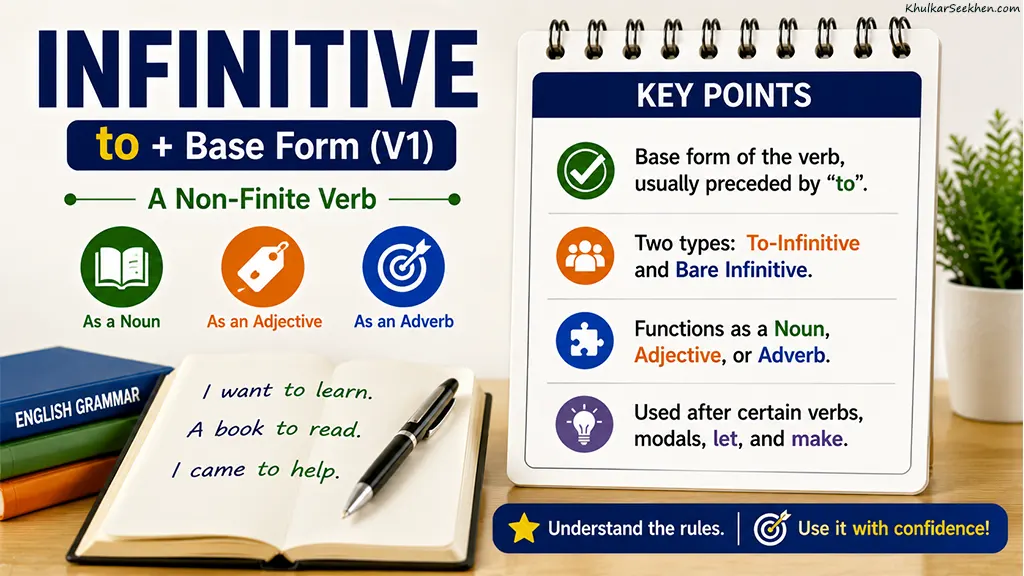
An Infinitive is one of the three types of Non-finite Verbs. It is the basic form of a verb, usually preceded by to. Unlike finite verbs, infinitives do not change according to the subject, person, number, or tense.
Infinitives can function as nouns, adjectives, or adverbs in a sentence.
In this lesson, you will learn:
- What is an Infinitive?
- Types of Infinitives
- Uses of Infinitives
- To-Infinitive and Bare Infinitive
- Difference between Infinitives and Gerunds
- Common mistakes
- Exercises with answers
What is an Infinitive?
Read the following sentences.
- I want to learn English.
- She decided to join the course.
- They came to help us.
The highlighted words are Infinitives.
Although they contain verbs, they do not function as the main verb of the sentence.
Definition
An Infinitive is the base form (V1) of a verb, usually preceded by “to”, that functions as a noun, adjective, or adverb in a sentence.
Examples:
- to read
- to write
- to play
- to study
- to help
Structure of an Infinitive
To + Base Form (V1)
Examples:
- to eat
- to sing
- to walk
- to dance
- to write
Types of Infinitives
There are two main types of infinitives.
- To-Infinitive
- Bare Infinitive
1. To-Infinitive
A To-Infinitive consists of to + base form (V1).
Examples:
- to read
- to write
- to play
Sentences:
- I hope to meet you soon.
- She wants to become a doctor.
- They agreed to help us.
2. Bare Infinitive
A Bare Infinitive is the base form of a verb without “to”.
It is used after certain verbs and modal auxiliaries.
Examples:
- can swim
- must work
- should study
Notice that to is omitted.
When Do We Use Bare Infinitives?
A. After Modal Verbs
Examples:
- She can swim.
- We should study.
- You must obey the rules.
- They will arrive tomorrow.
B. After let
Examples:
- Let me go.
- Let him speak.
C. After make (Active Voice)
Examples:
- The teacher made us write the answers.
- His parents made him apologise.
Note: In the passive voice, to is used again:
✔ We were made to write the answers.
D. After Verbs of Perception
Examples:
- I saw him cross the road.
- We heard her sing.
If the action is ongoing, we often use the -ing form:
- I saw him crossing the road.
Uses of Infinitives
An infinitive can function in different ways.
1. Infinitive as a Noun
It can act as the subject or object of a sentence.
Subject:
- To forgive is divine.
- To travel broadens the mind.
Object:
- I like to read.
- She wants to study abroad.
2. Infinitive as an Adjective
An infinitive can describe a noun.
Examples:
- I have a book to read.
- She needs a chair to sit on.
- He found no time to rest.
3. Infinitive as an Adverb
It can explain why, how, or to what purpose an action is performed.
Examples:
- We went to Delhi to attend a conference.
- He works hard to support his family.
- She came to meet her teacher.
Infinitive After Certain Verbs
Some verbs are commonly followed by a to-infinitive.
Examples include:
- agree
- decide
- hope
- learn
- manage
- plan
- promise
- refuse
- want
- wish
Examples:
- She decided to leave.
- We hope to win.
- He refused to answer.
Infinitive After Adjectives
Infinitives are often used after adjectives.
Examples:
- happy to help
- ready to leave
- eager to learn
- difficult to understand
- easy to solve
Sentences:
- I am happy to help you.
- She is eager to learn.
- This question is difficult to solve.
Infinitive to Show Purpose
One of the most common uses of an infinitive is to express purpose.
Examples:
- He went to the market to buy vegetables.
- I study hard to score good marks.
- She saved money to buy a laptop.
Here, the infinitive answers the question “Why?”
Infinitive vs Gerund
Many learners confuse infinitives with gerunds.
| Infinitive | Gerund |
|---|---|
| to read | reading |
| Usually begins with to | Ends with -ing |
| Often expresses purpose or intention | Often names an activity or acts as a noun |
| I want to read. | Reading is enjoyable. |
Some verbs can be followed by either an infinitive or a gerund, sometimes with a change in meaning (for example, remember, forget, stop, try). These differences are covered in advanced grammar.
Common Mistakes
✘ He can to swim.
✔ He can swim.
✘ She made me to laugh.
✔ She made me laugh.
✘ I want learning English.
✔ I want to learn English.
✘ We enjoyed to play cricket.
✔ We enjoyed playing cricket.
(Enjoy is followed by a gerund, not an infinitive.)
✘ He went market to buying vegetables.
✔ He went to the market to buy vegetables.
Quick Revision Table
| Use | Example |
|---|---|
| Subject | To forgive is divine. |
| Object | I want to study. |
| Adjective | I have work to finish. |
| Adverb (Purpose) | She came to help. |
| After Modal | She can sing. |
| After let | Let him go. |
| After make (Active) | They made us wait. |
Summary
- An Infinitive is the base form of a verb, usually preceded by to.
- It is a non-finite verb and does not change according to the subject or tense.
- There are two types of infinitives:
- To-Infinitive
- Bare Infinitive
- Infinitives can function as nouns, adjectives, and adverbs.
- Bare infinitives are used after modal verbs, let, make (in the active voice), and certain verbs of perception.
Practice Exercise 1
Identify the infinitive in each sentence and state its function (Noun, Adjective, or Adverb).
- I want to become a pilot.
- To help others is a noble act.
- She bought a notebook to write in.
- They came to congratulate us.
- He has a lot of work to complete.
- We hope to meet you again.
- To speak politely costs nothing.
- She is eager to learn French.
- I need someone to guide me.
- He studies hard to succeed.
Practice Exercise 2
Choose the correct answer.
- An infinitive usually consists of:
- (a) Verb + ing
- (b) to + base form of the verb
- (c) Past participle
- (d) Helping verb
- Which sentence contains a bare infinitive?
- (a) I want to sleep.
- (b) She hopes to win.
- (c) We can swim.
- (d) They like to dance.
- Which sentence uses an infinitive to express purpose?
- (a) To read is enjoyable.
- (b) She came to help me.
- (c) He wants to study.
- (d) I have a book to read.
- Which sentence is correct?
- (a) He can to drive.
- (b) He can drive.
- (c) He can driving.
- (d) He can drove.
- Which verb is normally followed by a gerund rather than an infinitive?
- (a) enjoy
- (b) decide
- (c) hope
- (d) promise
Answers Exercise 1
- to become – Noun (Object)
- To help – Noun (Subject)
- to write – Adjective (modifies notebook)
- to congratulate – Adverb (Purpose)
- to complete – Adjective (modifies work)
- to meet – Noun (Object)
- To speak – Noun (Subject)
- to learn – Completes the adjective eager (often treated as an adjective complement)
- to guide – Adjective (modifies someone)
- to succeed – Adverb (Purpose)
Answers Exercise 2
- (b) to + base form of the verb
- (c) We can swim.
- (b) She came to help me.
- (b) He can drive.
- (a) enjoy
