Modal verbs are special helping verbs that express the speaker’s attitude or intention. They do not describe the main action themselves; instead, they modify the meaning of the main verb.
We use modal verbs to express:
- Ability
- Permission
- Possibility
- Probability
- Advice
- Obligation
- Necessity
- Requests
- Offers
- Suggestions
In this lesson, you will learn:
- What are Modal Verbs?
- Rules for using Modals
- List of Modal Verbs
- Uses of each Modal Verb
- Differences between commonly confused modals
- Common mistakes
- Exercises with answers
What are Modal Verbs?
Read the following sentences.
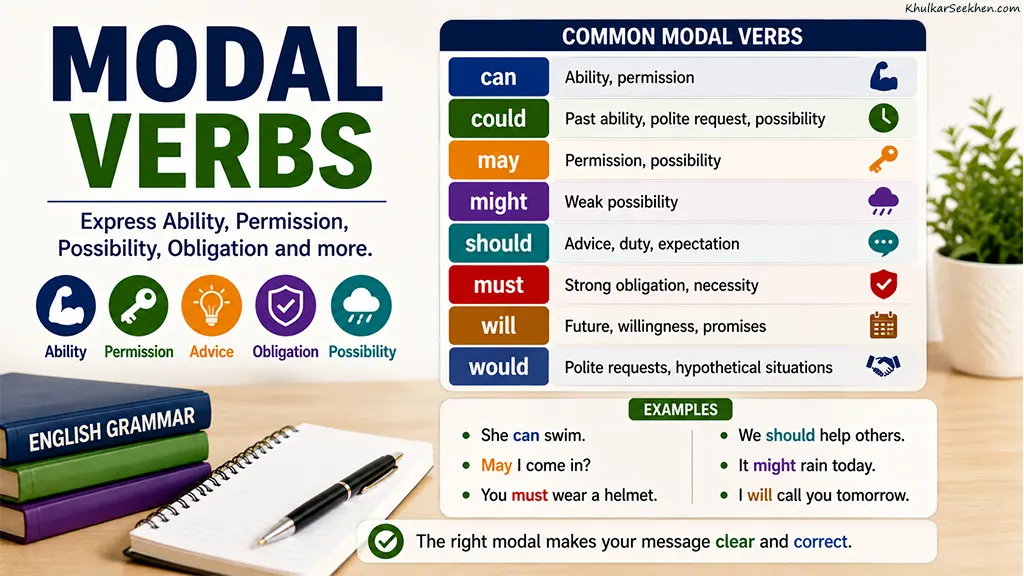
- She can swim.
- May I come in?
- You must wear a helmet.
- We should help others.
- It might rain today.
The highlighted words are Modal Verbs. They help the main verb express ability, permission, possibility, or necessity.
Definition
A Modal Verb is a type of auxiliary (helping) verb that expresses ability, permission, possibility, probability, advice, obligation, willingness, or necessity.
List of Common Modal Verbs
| Modal Verb | Main Use |
|---|---|
| can | ability, permission |
| could | past ability, polite request, possibility |
| may | permission, possibility |
| might | weak possibility |
| shall | future (formal), offers, suggestions |
| should | advice, duty, expectation |
| will | future, willingness |
| would | polite requests, habits in the past, imaginary situations |
| must | necessity, obligation, strong deduction |
| ought to | moral duty, advice |
| need (modal) | necessity (mainly in negatives and questions) |
| dare (modal) | courage, challenge (less common) |
Rules for Using Modal Verbs
Rule 1: Modal + Base Form (V1)
A modal verb is always followed by the base form (V1) of the main verb.
✔ She can swim.
✔ We must study.
✘ She can swims.
✘ He must studies.
Rule 2: Modals Do Not Change Their Form
Modal verbs remain the same for all subjects.
✔ I can swim.
✔ She can swim.
✔ They can swim.
✘ He cans swim.
Rule 3: Only One Modal Is Used Before the Main Verb
✔ You should work hard.
✘ You will should work hard.
Uses of Individual Modal Verbs
1. Can
Uses
- Ability
- Informal permission
- Possibility
Examples
- She can speak English.
- Birds can fly.
- Can I borrow your pen?
2. Could
Uses
- Past ability
- Polite request
- Possibility
Examples
- She could swim at the age of five.
- Could you help me?
- It could rain this evening.
Difference: Can vs Could
| Can | Could |
|---|---|
| Present ability | Past ability |
| Informal request | Polite request |
| Strong possibility | Weaker possibility |
Examples:
- I can solve this problem.
- I could solve this problem when I was younger.
- Could you please open the window?
3. May
Uses
- Formal permission
- Possibility
Examples
- May I come in?
- It may rain today.
4. Might
Uses
- Weak possibility
Examples
- We might visit Jaipur next month.
- She might be busy.
Difference: May vs Might
| May | Might |
|---|---|
| Greater possibility | Lesser possibility |
| Formal permission | Usually not used for permission in modern English |
Examples:
- It may rain. (Quite possible)
- It might rain. (Less certain)
5. Shall
Uses
- Offers
- Suggestions
- Formal future (mainly in legal or official English)
Examples
- Shall we go for a walk?
- Shall I open the window?
6. Should
Uses
- Advice
- Duty
- Recommendation
- Expectation
Examples
- You should exercise regularly.
- We should respect our elders.
- The train should arrive soon.
Difference: Must vs Should
| Must | Should |
|---|---|
| Strong obligation | Advice or recommendation |
| No choice | Choice remains |
Examples:
- You must wear a seat belt.
- You should drink more water.
7. Will
Uses
- Future actions
- Willingness
- Promises
Examples
- I will call you tomorrow.
- She will help you.
- We will never forget your kindness.
8. Would
Uses
- Polite requests
- Past habits
- Imaginary situations
Examples
- Would you help me?
- When we were children, we would play outside every evening.
- I would buy a new car if I had enough money.
Difference: Will vs Would
| Will | Would |
|---|---|
| Future certainty | Polite request or hypothetical situation |
| Direct | More polite or less certain |
Examples:
- I will help you.
- Would you help me?
9. Must
Uses
- Strong obligation
- Necessity
- Strong conclusion (deduction)
Examples
- You must wear a helmet.
- Students must follow school rules.
- She has scored 99%; she must be very happy.
10. Ought to
Uses
- Moral duty
- Advice
Examples
- We ought to help the poor.
- You ought to respect your parents.
11. Need (Modal)
Usually used in negative sentences and questions.
Examples
- You need not worry.
- Need I say more?
Note: In modern English, need is more commonly used as a main verb (e.g., You need to study.).
12. Dare (Modal)
Used to express courage or challenge.
Examples
- Dare you question me?
- He dare not speak the truth.
(In the second example, ‘dare not’ is a modal, but when we write it ‘dares not’, then it’ll be a main verb.)
Note: Like need, dare is more commonly used as a main verb today (e.g., He didn’t dare to ask.).
Common Mistakes
✘ He can sings.
✔ He can sing.
✘ She must goes.
✔ She must go.
✘ He cans swim.
✔ He can swim.
✘ May you help me?
✔ Could you help me?
✘ He will can come.
✔ He will come.
Quick Revision Table
| Modal | Main Function |
|---|---|
| can | Ability, permission |
| could | Past ability, polite request |
| may | Permission, possibility |
| might | Weak possibility |
| shall | Offers, suggestions |
| should | Advice |
| will | Future, willingness |
| would | Polite request, hypothetical situations |
| must | Strong obligation, necessity |
| ought to | Moral duty |
| need | Necessity |
| dare | Courage |
Summary
- Modal verbs are special helping verbs.
- They are followed by the base form (V1) of the main verb.
- Modal verbs do not change according to the subject.
- They express ability, permission, advice, possibility, obligation, willingness, and necessity.
- Choosing the correct modal depends on the meaning you want to convey.
Practice Exercise 1
Fill in the blanks with the most suitable modal verb.
- You ________ wear a seat belt while driving.
- ________ I borrow your notebook?
- She ________ speak three languages fluently.
- We ________ leave now, or we will miss the train.
- It ________ rain this evening, so carry an umbrella.
- You ________ eat more fruits and vegetables.
- ________ you please help me with this project?
- They ________ arrive late because of the traffic.
- Students ________ respect their teachers.
- I ________ visit my grandparents next weekend.
Practice Exercise 2
Choose the correct answer.
- Which modal verb expresses strong obligation?
- (a) can
- (b) should
- (c) must
- (d) might
- Which modal is generally used for polite requests?
- (a) could
- (b) must
- (c) shall
- (d) ought to
- Which sentence is correct?
- (a) She can sings well.
- (b) She can sing well.
- (c) She cans sing well.
- (d) She can to sing well.
- Which modal expresses advice?
- (a) should
- (b) must
- (c) can
- (d) may
- Which modal expresses a weaker possibility?
- (a) may
- (b) must
- (c) might
- (d) will
Answers Exercise 1
- must
- May (or Can, depending on formality)
- can
- must (or should, depending on context)
- might (or may)
- should
- Could
- might
- should
- will
Answers Exercise 2
- (c) must
- (a) could
- (b) She can sing well.
- (a) should
- (c) might
