The Simple Present Tense (also called the Present Indefinite Tense) is one of the most frequently used tenses in English. It is used to describe habits, routines, universal truths, scientific facts, scheduled events, and permanent situations.
Although it is called the Present Tense, it is not used only for actions happening now. Instead, it mainly describes actions that are regular, repeated, or generally true.
In this lesson, you will learn:
- What is the Simple Present Tense?
- Structure of sentences
- Rules for using do, does, s, and es
- Uses with examples
- Time expressions (signal words)
- Common mistakes
- Exercises with answers
What is the Simple Present Tense?
Read the following sentences.
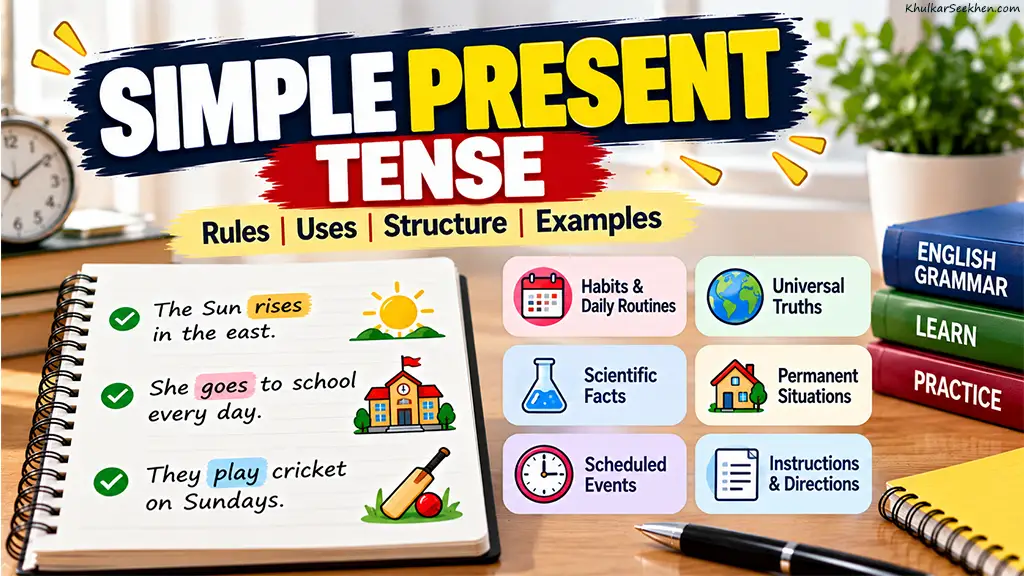
- The Sun rises in the east.
- I go for a walk every morning.
- She teaches Mathematics.
- Birds build nests.
- Do you play football?
These sentences describe actions that happen regularly or facts that are always true.
Definition
The Simple Present Tense is used to express habitual actions, daily routines, universal truths, scientific facts, permanent situations, and scheduled events.
It is also known as the Present Indefinite Tense.
Structure of the Simple Present Tense
1. Affirmative Sentences
| Subject | Verb | Example |
|---|---|---|
| I/We/You/They | V¹ | They play football. |
| He/She/It | V¹ + s/es | She plays football. |
Examples:
- I read newspapers every day.
- We study English.
- You speak politely.
- They live in Delhi.
- He writes poems.
- She teaches Science.
- It rains heavily in July.
2. Negative Sentences
| Subject | Helping Verb | Main Verb |
|---|---|---|
| I/We/You/They | do not (don’t) | V¹ |
| He/She/It | does not (doesn’t) | V¹ |
Examples:
- I do not eat junk food.
- They do not waste water.
- She does not watch television daily.
- He does not tell lies.
3. Interrogative Sentences
| Helping Verb | Subject | Verb |
|---|---|---|
| Do | I/We/You/They | V¹ |
| Does | He/She/It | V¹ |
Examples:
- Do you play cricket?
- Does she speak French?
- Do they help their parents?
- Does Rahul go to school by bus?
4. WH-Questions
Structure:
WH Word + do/does + subject + verb?
Examples:
- Why do you wake up early?
- Where does she live?
- What do they teach?
- When does the train leave?
Formation Rules
Rule 1: Add -s or -es with Third Person Singular
Add -s or -es when the subject is:
- He
- She
- It
- Singular noun
Examples:
- He reads books.
- She sings beautifully.
- The child laughs happily.
Rule 2: When to Add -es
Add -es if the verb ends in:
- s
- ss
- sh
- ch
- x
- z
- o
Examples:
| Base Verb | Simple Present |
|---|---|
| go | goes |
| do | does |
| wash | washes |
| watch | watches |
| pass | passes |
| fix | fixes |
Rule 3: Verbs Ending in Consonant + y
Change y into ies.
| Base Verb | Third Person |
|---|---|
| study | studies |
| carry | carries |
| cry | cries |
| fly | flies |
Examples:
- She studies hard.
- He carries heavy bags.
Rule 4: Vowel + y
Simply add -s.
Examples:
- play → plays
- enjoy → enjoys
- buy → buys
Uses of the Simple Present Tense
1. Habitual Actions
Actions performed regularly.
Examples:
- I wake up at 6 a.m.
- She drinks milk every morning.
- They exercise daily.
2. Daily Routine
Examples:
- My father leaves for work at 9 a.m.
- We attend school every weekday.
3. Universal Truths
Examples:
- The Earth revolves around the Sun.
- Water boils at 100°C.
- The Sun rises in the east.
4. Scientific Facts
Examples:
- Plants need sunlight.
- Metals conduct electricity.
- Ice melts above 0°C.
5. Permanent Situations
Examples:
- She lives in Mumbai.
- My uncle works in a bank.
6. Scheduled Events
Used for official schedules and timetables.
Examples:
- The train leaves at 6:30 a.m.
- The examination begins on Monday.
- The shop opens at 9 a.m.
7. Instructions and Directions
Examples:
- First, mix the flour with water.
- Turn left at the traffic signal.
- Open the window.
8. Newspaper Headlines
Examples:
- India Wins the Championship
- Government Announces New Policy
9. Sports Commentary
Examples:
- Kohli hits a six.
- The goalkeeper saves the penalty.
Signal Words
These words often indicate the Simple Present Tense.
- always
- usually
- generally
- often
- sometimes
- never
- every day
- every week
- every month
- every year
- daily
- regularly
Examples:
- She always helps others.
- We usually walk to school.
Spelling Rules
| Verb | Third Person |
|---|---|
| work | works |
| read | reads |
| go | goes |
| wash | washes |
| study | studies |
| enjoy | enjoys |
Simple Present vs Present Continuous
| Simple Present | Present Continuous |
|---|---|
| Habit | Action happening now |
| She studies every day. | She is studying now. |
| General truth | Temporary action |
Common Mistakes
✘ He go to school.
✔ He goes to school.
✘ She don’t like tea.
✔ She doesn’t like tea.
✘ Does she goes to school?
✔ Does she go to school?
✘ He does not studies.
✔ He does not study.
✘ I am knowing the answer.
✔ I know the answer.
(“Know” is a stative verb and is generally not used in the continuous tense.)
Quick Revision Table
| Sentence Type | Structure |
|---|---|
| Affirmative | Subject + V¹/V¹+s(es) |
| Negative | Subject + do/does not + V¹ |
| Interrogative | Do/Does + Subject + V¹? |
| WH-Question | WH + do/does + Subject + V¹? |
Summary
- The Simple Present Tense is also called the Present Indefinite Tense.
- It is used for habits, routines, universal truths, scientific facts, permanent situations, and scheduled events.
- Add -s or -es to the verb when the subject is he, she, it, or a singular noun.
- Use do and does to form negative and interrogative sentences.
- The main verb always remains in its base form after do or does.
Practice Exercise 1
Fill in the blanks with the correct form of the verb.
- She ________ (go) to school every day.
- The Sun ________ (rise) in the east.
- They ________ (play) football on Sundays.
- My father ________ (work) in a hospital.
- Rahul ________ (study) English every evening.
- We ________ (not/watch) television during exams.
- ________ she ________ (like) chocolate?
- Why ________ you ________ (wake) up so early?
- The train ________ (leave) at 7:00 a.m.
- My sister ________ (carry) her own bag.
Practice Exercise 2
Choose the correct answer.
- Which sentence is correct?
- (a) He go to school.
- (b) He goes to school.
- (c) He going to school.
- (d) He gone to school.
- Which helping verb is used with she?
- (a) do
- (b) did
- (c) does
- (d) has
- Which sentence expresses a universal truth?
- (a) I am reading.
- (b) Water boils at 100°C.
- (c) We played yesterday.
- (d) She will travel tomorrow.
- Which verb is correctly formed?
- (a) studys
- (b) studys
- (c) studies
- (d) studyes
- Which sentence is correct?
- (a) Does he plays football?
- (b) Does he play football?
- (c) Do he play football?
- (d) He does plays football.
Answers Exercise 1
- goes
- rises
- play
- works
- studies
- do not watch
- Does, like
- do, wake
- leaves
- carries
Answers Exercise 2
- (b) He goes to school.
- (c) does
- (b) Water boils at 100°C.
- (c) studies
- (b) Does he play football?
