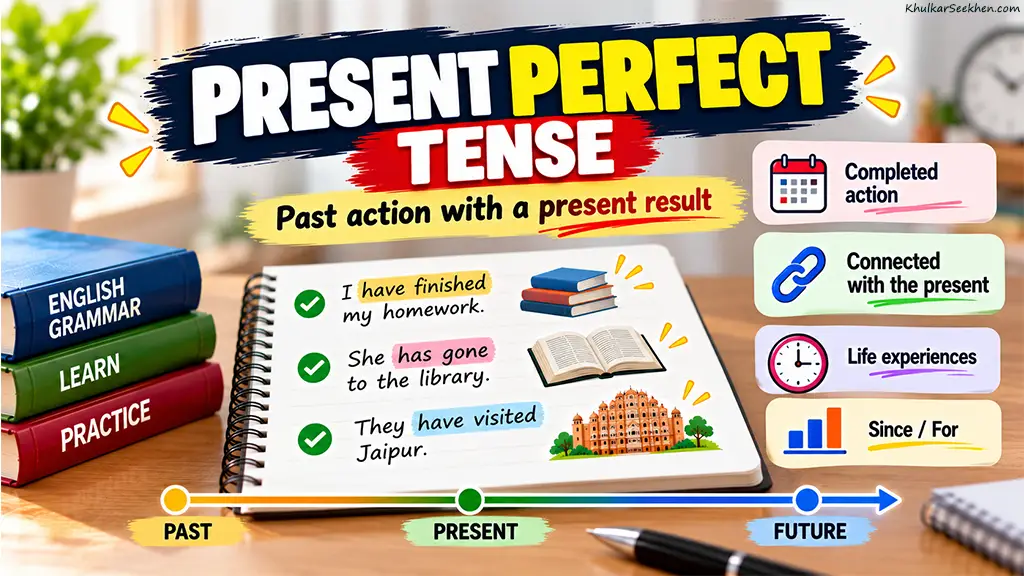
The Present Perfect Tense is used to describe actions that have been completed, but their result or effect is connected with the present. It is also used to talk about life experiences, recent events, and actions that happened at an unspecified time in the past.
Unlike the Simple Past Tense, which tells when something happened, the Present Perfect Tense focuses on what has happened, not exactly when it happened.
In this lesson, you will learn:
- What is the Present Perfect Tense?
- Sentence structure
- Rules for using has and have
- Uses with examples
- Since vs For
- Already, Yet, Just, Ever, Never
- Been vs Gone
- Common mistakes
- Exercises with answers
What is the Present Perfect Tense?
Read the following sentences.
- I have completed my homework.
- She has gone to the library.
- They have visited Jaipur.
- Rahul has broken his glasses.
- Have you ever seen the Taj Mahal?
In all these sentences, the action is complete, but its result is important now.
Definition
The Present Perfect Tense is used to describe completed actions that have a connection with the present, actions that happened at an unspecified time in the past, and experiences up to the present.
It is formed using has/have + past participle (V³).
Structure of the Present Perfect Tense
1. Affirmative Sentences
| Subject | Helping Verb | Main Verb |
|---|---|---|
| I/We/You/They | have | V³ |
| He/She/It | has | V³ |
Examples:
- I have finished my homework.
- We have cleaned the classroom.
- She has written a letter.
- Rahul has won the competition.
2. Negative Sentences
| Subject | Helping Verb | Not | Main Verb |
|---|---|---|---|
| I/We/You/They | have | not | V³ |
| He/She/It | has | not | V³ |
Examples:
- I have not completed the project.
- She has not arrived yet.
- They have not seen the movie.
3. Interrogative Sentences
| Helping Verb | Subject | Main Verb |
|---|---|---|
| Have | I/We/You/They | V³ |
| Has | He/She/It | V³ |
Examples:
- Have you finished your work?
- Has she called you?
- Have they reached home?
4. WH-Questions
WH Word + has/have + Subject + V³?
Examples:
- Where have you kept my book?
- Why has he left early?
- What have they decided?
- How has she solved the problem?
When to Use the Present Perfect Tense
1. Completed Action with Present Result
The action is complete, but its effect continues.
Examples:
- I have lost my wallet. (I don’t have it now.)
- She has broken her phone. (It is still broken.)
- The baby has fallen asleep. (The baby is sleeping now.)
2. Life Experiences
Used with ever, never, before.
Examples:
- I have visited Agra twice.
- Have you ever travelled by airplane?
- She has never seen snow.
- We have never eaten sushi.
3. Recent Actions
Often used with just, recently, lately.
Examples:
- I have just finished lunch.
- She has recently changed her job.
- They have just arrived.
4. Actions Completed at an Unspecified Time
The exact time is not important.
Examples:
- He has written three novels.
- They have won many awards.
- We have watched that film.
5. Actions Continuing Until Now
Usually with since and for.
Examples:
- I have lived here for ten years.
- She has worked in this company since 2020.
- They have known each other for a long time.
Since vs For
These expressions are used to show duration.
| Since | For |
|---|---|
| Starting point | Length of time |
| since 2020 | for three years |
| since Monday | for a week |
| since 8 a.m. | for two hours |
| since childhood | for a long time |
Examples:
- She has lived here since 2018.
- We have studied together for five years.
Already, Yet, Just
Already
Shows something happened earlier than expected.
Examples:
- I have already completed the assignment.
- She has already left.
Yet
Usually used in negative and interrogative sentences.
Examples
- I haven’t finished my homework yet.
- Have you eaten yet?
Just
Shows a very recent action.
Examples
- He has just arrived.
- We have just finished dinner.
Ever and Never
Ever
Used mainly in questions.
- Have you ever visited Kashmir?
Never
Means “not at any time.”
- I have never ridden a horse.
Been vs Gone
Students often confuse these two words.
| Been | Gone |
|---|---|
| Person went and returned. | Person went and has not returned yet. |
Examples:
- I have been to Goa twice. (I returned.)
- My father has gone to Delhi. (He is still there.)
Present Perfect vs Simple Past
| Present Perfect | Simple Past |
|---|---|
| Time not mentioned | Time mentioned |
| I have seen the movie. | I saw the movie yesterday. |
| Present result | Completed past action |
| Have you ever visited Jaipur? | Did you visit Jaipur last year? |
Signal Words
These words often indicate the Present Perfect Tense.
- already
- yet
- just
- ever
- never
- recently
- lately
- so far
- till now
- up to now
- since
- for
Common Mistakes
✘ I have seen him yesterday.
✔ I saw him yesterday.
(Do not use the Present Perfect with finished past time expressions like yesterday, last week, or in 2022.)
✘ She has went home.
✔ She has gone home.
✘ He have finished his work.
✔ He has finished his work.
✘ Did you ever visit Delhi?
✔ Have you ever visited Delhi?
✘ I have lived here since five years.
✔ I have lived here for five years.
✘ She has been to Mumbai yesterday.
✔ She went to Mumbai yesterday.
Quick Revision Table
| Sentence Type | Structure |
|---|---|
| Affirmative | Subject + has/have + V³ |
| Negative | Subject + has/have + not + V³ |
| Interrogative | Has/Have + Subject + V³? |
| WH-Question | WH + has/have + Subject + V³? |
Summary
- The Present Perfect Tense connects the past with the present.
- It is formed using has/have + past participle (V³).
- It is used for completed actions with present results, life experiences, recent actions, and actions continuing until now.
- Use since for a starting point and for for a period of time.
- Do not use the Present Perfect with completed past time expressions such as yesterday, last year, or in 2020.
Practice Exercise 1
Fill in the blanks with the correct form of the verb.
- She ________ (finish) her homework.
- I ________ never ________ (visit) Kerala.
- They ________ (live) here since 2019.
- ________ you ever ________ (see) the Red Fort?
- Rahul ________ just ________ (leave).
- We ________ not ________ (complete) the project yet.
- My brother ________ (write) two novels.
- She ________ (know) him for ten years.
- The train ________ already ________ (arrive).
- He ________ (go) to the market.
Practice Exercise 2
Choose the correct answer.
- Which helping verb is used with she?
- (a) have
- (b) has
- (c) had
- (d) will
- Which sentence is correct?
- (a) She has wrote a letter.
- (b) She has written a letter.
- (c) She has write a letter.
- (d) She written a letter.
- Which word is commonly used in questions about life experiences?
- (a) already
- (b) ever
- (c) yesterday
- (d) tomorrow
- Which sentence is correct?
- (a) I have seen him yesterday.
- (b) I saw him yesterday.
- (c) I have saw him yesterday.
- (d) I seen him yesterday.
- Which sentence correctly uses been?
- (a) She has been to Agra twice.
- (b) She has gone to Agra twice.
- (c) She has went to Agra twice.
- (d) She has go to Agra twice.
Answers Exercise 1
- has finished
- have, visited
- have lived
- Have, seen
- has, left
- have, completed
- has written
- has known
- has, arrived
- has gone
Answers Exercise 2
- (b) has
- (b) She has written a letter.
- (b) ever
- (b) I saw him yesterday.
- (a) She has been to Agra twice.
