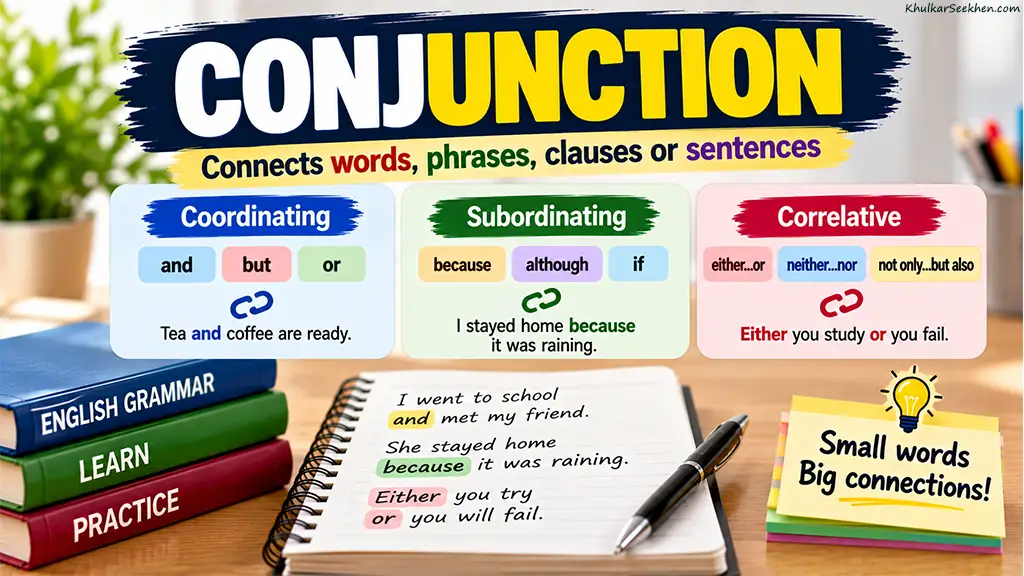
A Conjunction is one of the eight parts of speech. It is used to connect words, phrases, clauses, or sentences. Conjunctions help us express ideas clearly and show relationships such as addition, contrast, choice, reason, condition, and time.
Without conjunctions, our speech and writing would become repetitive and disconnected.
In this lesson, you will learn:
- What is a Conjunction?
- Types of Conjunctions
- Coordinating Conjunctions
- Subordinating Conjunctions
- Correlative Conjunctions
- Common mistakes
- Exercises with answers
What is a Conjunction?
Read the following sentences.
- Ranjana and Pramod are doctors.
- Rajeev likes bread and jam.
- Vegetables are cheap but fruits are expensive.
- Breakfast is free but lunch has to be bought.
- My pencil is in the cupboard or on the shelf.
The highlighted words connect different parts of the sentences.
These words are Conjunctions.
Definition
A Conjunction is a word or group of words used to join words, phrases, clauses, or sentences.
What Can a Conjunction Join?
| Joins | Example |
|---|---|
| Words | Tea and coffee |
| Phrases | In the morning or in the evening |
| Clauses | She was tired, but she continued working. |
| Sentences | It was raining, so we stayed indoors. |
Types of Conjunctions
There are three main types of conjunctions:
- Coordinating Conjunctions
- Subordinating Conjunctions
- Correlative Conjunctions
1. Coordinating Conjunctions
A Coordinating Conjunction joins words, phrases, or independent clauses of equal importance.
The seven coordinating conjunctions can be remembered using the acronym FANBOYS.
| Letter | Conjunction | Use |
|---|---|---|
| F | For | Reason |
| A | And | Addition |
| N | Nor | Negative alternative |
| B | But | Contrast |
| O | Or | Choice |
| Y | Yet | Contrast |
| S | So | Result |
And
Used to add similar ideas.
Examples:
- Tommy is a boy and Margie is a girl.
- She bought books and notebooks.
But
Shows contrast.
Examples:
- Kezia’s father was kind, but she feared him.
- He is poor but honest.
Or
Shows choice.
Examples:
- Take tea or coffee.
- You may stay or leave.
Nor
Joins two negative ideas.
Examples:
- He did not call, nor did he send a message.
- She cannot sing, nor can she dance.
Yet
Shows an unexpected contrast.
Examples:
- He worked hard, yet he failed.
- She is young, yet very wise.
So
Shows result.
Examples:
- It was raining, so we stayed home.
- I was tired, so I went to bed.
For
Shows reason (formal style).
Example:
- I stayed home, for I was unwell.
2. Subordinating Conjunctions
A Subordinating Conjunction joins a dependent clause to an independent clause.
It introduces ideas such as:
- Time
- Cause
- Condition
- Purpose
- Contrast
- Place
Common Subordinating Conjunctions
after, before, because, since, if, unless, although, though, even though, while, when, whenever, where, wherever, until, as, so that
Time
- I reached the station after the train had left.
- Call me when you arrive.
Reason
- I stayed home because I was ill.
- We cancelled the trip since it was raining.
Condition
- If you study hard, you will succeed.
- You cannot enter unless you have a ticket.
Contrast
- Although she was tired, she finished her work.
- Even though he apologized, she remained upset.
Purpose
- Study hard so that you can achieve your goals.
Place
- Sit where you feel comfortable.
3. Correlative Conjunctions
Correlative Conjunctions work in pairs to connect words or groups of words with equal grammatical structure.
Either…or
Shows a choice.
Example
- You can either stay or leave.
Neither…nor
Shows two negative alternatives.
Example
- Neither Rahul nor Mohan attended the meeting.
Both…and
Shows addition.
Example
- Both Riya and Simran won prizes.
Not only…but also
Adds emphasis.
Example
- She is not only intelligent but also hardworking.
Whether…or
Shows alternatives.
Example
- I don’t know whether he will come or not.
As Well As
As well as is not a coordinating conjunction. It functions as a preposition-like connector.
The verb agrees with the first subject.
Correct
- The teacher, as well as the students, was present.
Incorrect
- The teacher, as well as the students, were present.
Position of Conjunctions
Conjunctions are usually placed:
- Between words
- Between phrases
- Between clauses
- At the beginning of a dependent clause
Examples
- Apples and oranges
- Before dinner and after lunch
- I was late because my bus was delayed.
Punctuation with Conjunctions
Comma Before Coordinating Conjunction
Use a comma before and, but, or, so, yet, for, nor when they join two independent clauses.
✔ I wanted to go, but it started raining.
No comma is usually needed when joining simple words or short phrases.
✔ Tea and coffee
✔ Rahul and Mohan
Common Mistakes
✘ Although he was tired but he worked.
✔ Although he was tired, he worked.
OR
✔ He was tired, but he worked.
(Do not use although and but together.)
✘ Because he was ill, so he stayed home.
✔ Because he was ill, he stayed home.
OR
✔ He was ill, so he stayed home.
✘ Neither Rohan or Mohan came.
✔ Neither Rohan nor Mohan came.
✘ Either you study and fail.
✔ Either you study or fail.
✘ The teacher as well as the students were present.
✔ The teacher as well as the students was present.
Quick Revision Table
| Conjunction | Function | Example |
|---|---|---|
| and | Addition | Tea and coffee |
| but | Contrast | Poor but honest |
| or | Choice | Tea or coffee |
| so | Result | It rained, so we stayed home. |
| because | Reason | I stayed because I was ill. |
| although | Contrast | Although tired, she worked. |
| if | Condition | If you try, you will succeed. |
| unless | Negative condition | Unless you study, you will fail. |
| either…or | Choice | Either Ravi or Mohan |
| neither…nor | Negative choice | Neither A nor B |
| not only…but also | Addition with emphasis | Not only smart but also kind |
Summary
- A Conjunction joins words, phrases, clauses, or sentences.
- There are three main types:
- Coordinating Conjunctions
- Subordinating Conjunctions
- Correlative Conjunctions
- Coordinating conjunctions connect ideas of equal importance.
- Subordinating conjunctions connect a dependent clause with an independent clause.
- Correlative conjunctions always work in pairs.
- Avoid using although…but and because…so together.
Practice Exercise 1
Fill in the blanks with the correct conjunction.
- Girish went to the market ________ Harish went to the cricket ground.
- ________ I worked hard, I got good marks.
- ________ she ________ you came to my wedding ceremony.
- My elder sister is very wise ________ my younger one is careless.
- Black absorbs heat ________ white reflects it.
- ________ Harish hurried, he was late for the movie.
- Zoya went home ________ she had finished her work.
- I bought a dictionary ________ I could learn more spellings.
- ________ it rains, the picnic will be cancelled.
- I like her ________ she is hardworking.
Practice Exercise 2
Choose the correct answer.
- Which conjunction shows contrast?
- (a) and
- (b) but
- (c) or
- (d) so
- Which pair is a correlative conjunction?
- (a) because
- (b) although
- (c) either…or
- (d) while
- Which conjunction introduces a condition?
- (a) if
- (b) but
- (c) and
- (d) for
- Which sentence is correct?
- (a) Although he was tired but he worked.
- (b) Because it rained so we stayed home.
- (c) Although he was tired, he worked.
- (d) Neither Ravi or Mohan came.
- Which coordinating conjunction expresses a result?
- (a) so
- (b) yet
- (c) nor
- (d) but
Answers Exercise 1
- while
- Because
- Either … or
- but
- while
- Although
- after
- so that
- If
- because
Answers Exercise 2
- (b) but
- (c) either…or
- (a) if
- (c) Although he was tired, he worked.
- (a) so
