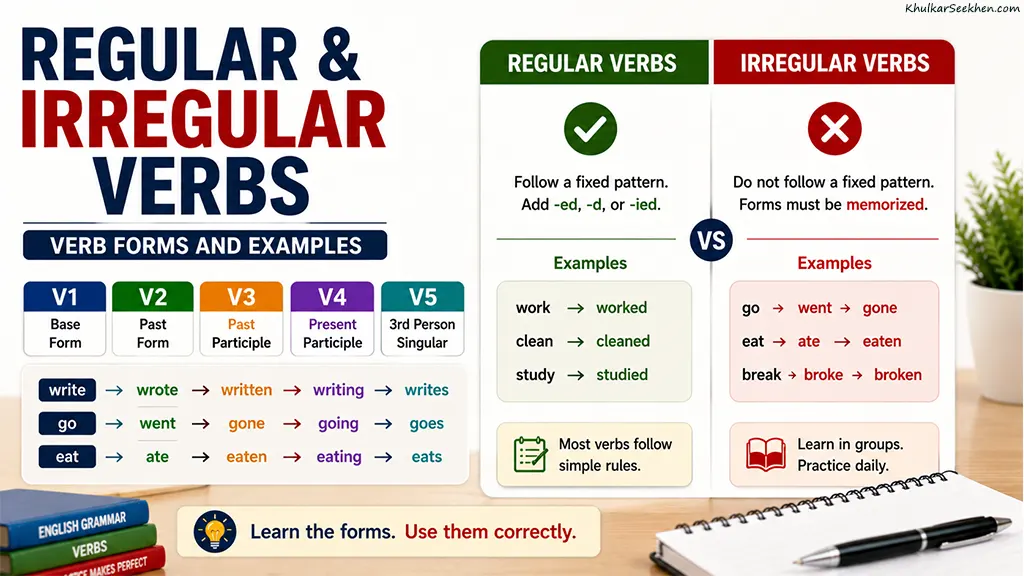
Regular and Irregular Verbs: Verbs change their forms to express time (tense), person, and number. These different forms are called verb forms.
Some verbs follow a fixed pattern while changing their forms, whereas others change irregularly.
Based on this, English verbs are divided into:
- Regular Verbs
- Irregular Verbs
Understanding these forms is essential for using English correctly.
What are Verb Forms?
Every main verb has different forms that are used in different tenses.
These forms are commonly called V1, V2, V3, V4, and V5.
| Form | Name | Example (Write) |
|---|---|---|
| V1 | Base Form | write |
| V2 | Past Form | wrote |
| V3 | Past Participle | written |
| V4 | Present Participle | writing |
| V5 | Third Person Singular | writes |
Another Example
| V1 | V2 | V3 | V4 | V5 |
|---|---|---|---|---|
| go | went | gone | going | goes |
| play | played | played | playing | plays |
| eat | ate | eaten | eating | eats |
Tip: V1, V2, and V3 are especially important for learning English tenses.
What is a Regular Verb?
Read the following examples.
| V1 | V2 | V3 |
|---|---|---|
| walk | walked | walked |
| play | played | played |
| clean | cleaned | cleaned |
Notice that these verbs follow a regular pattern by adding -d, -ed, or -ied.
Definition
A Regular Verb is a verb that forms its past tense (V2) and past participle (V3) by adding -d, -ed, or -ied to the base form.
Rules for Forming Regular Verbs
Rule 1: Add -ed
Most verbs form the past tense by adding -ed.
| V1 | V2 | V3 |
|---|---|---|
| work | worked | worked |
| clean | cleaned | cleaned |
| help | helped | helped |
Rule 2: Add -d
If the verb already ends with e, add only -d.
| V1 | V2 | V3 |
|---|---|---|
| live | lived | lived |
| love | loved | loved |
| move | moved | moved |
Rule 3: Change y to i and add -ed
If a verb ends in a consonant + y, change y to i before adding -ed.
| V1 | V2 | V3 |
|---|---|---|
| carry | carried | carried |
| study | studied | studied |
| marry | married | married |
Rule 4: Double the Final Consonant
If a one-syllable verb ends in consonant-vowel-consonant (CVC), double the final consonant before adding -ed.
| V1 | V2 | V3 |
|---|---|---|
| stop | stopped | stopped |
| plan | planned | planned |
| drop | dropped | dropped |
What is an Irregular Verb?
Now look at these verbs.
| V1 | V2 | V3 |
|---|---|---|
| go | went | gone |
| eat | ate | eaten |
| break | broke | broken |
| buy | bought | bought |
These verbs do not follow a fixed pattern.
Definition
An Irregular Verb is a verb that does not form its past tense and past participle by simply adding -d or -ed.
These forms must be learned individually.
Types of Irregular Verbs
For easier learning, irregular verbs can be grouped into four patterns.
Group 1: All Three Forms Are the Same
| V1 | V2 | V3 |
|---|---|---|
| cut | cut | cut |
| put | put | put |
| hit | hit | hit |
| hurt | hurt | hurt |
| let | let | let |
Group 2: V2 and V3 Are the Same
| V1 | V2 | V3 |
|---|---|---|
| buy | bought | bought |
| bring | brought | brought |
| teach | taught | taught |
| feel | felt | felt |
| build | built | built |
Group 3: V1 and V3 Are the Same
| V1 | V2 | V3 |
|---|---|---|
| come | came | come |
| become | became | become |
| run | ran | run |
Group 4: All Three Forms Are Different
| V1 | V2 | V3 |
|---|---|---|
| go | went | gone |
| break | broke | broken |
| eat | ate | eaten |
| write | wrote | written |
| see | saw | seen |
| speak | spoke | spoken |
| swim | swam | swum |
Commonly Used Irregular Verbs
| V1 | V2 | V3 |
|---|---|---|
| be | was/were | been |
| begin | began | begun |
| come | came | come |
| do | did | done |
| drink | drank | drunk |
| drive | drove | driven |
| eat | ate | eaten |
| fall | fell | fallen |
| forget | forgot | forgotten |
| give | gave | given |
| go | went | gone |
| know | knew | known |
| read | read (/red/) | read (/red/) |
| see | saw | seen |
| speak | spoke | spoken |
| take | took | taken |
| wear | wore | worn |
| write | wrote | written |
Regular vs Irregular Verbs
| Regular Verbs | Irregular Verbs |
|---|---|
| Follow a fixed pattern | Do not follow a fixed pattern |
| Usually add -ed | Forms must be memorized |
| work → worked | go → went |
| clean → cleaned | eat → ate |
Where Are Verb Forms Used?
V1
- Present Simple
- Infinitive
Example:
- I play cricket.
- I want to play.
V2
- Simple Past
Example:
- I played yesterday.
- She wrote a letter.
V3
- Perfect Tenses
- Passive Voice
Examples:
- I have written a letter.
- The work was completed.
V4
- Continuous Tenses
- Gerunds
- Participles
Examples:
- He is reading.
- Reading is a good habit.
V5
- Present Simple with third-person singular subjects
Examples:
- He writes.
- She goes.
Common Mistakes
✘ He goed home.
✔ He went home.
✘ I have ate breakfast.
✔ I have eaten breakfast.
✘ She has wrote a letter.
✔ She has written a letter.
✘ They have buy a new car.
✔ They have bought a new car.
✘ He stoped the car.
✔ He stopped the car.
Tips to Remember Irregular Verbs
- Learn verbs in groups rather than individually.
- Practice five to ten verbs every day.
- Make short sentences using each form.
- Revise frequently through speaking and writing.
Quick Summary
| Topic | Key Point |
|---|---|
| Regular Verbs | Follow a fixed pattern (-ed, -d, -ied) |
| Irregular Verbs | Do not follow a fixed pattern |
| V1 | Base Form |
| V2 | Past Form |
| V3 | Past Participle |
| V4 | Present Participle |
| V5 | Third Person Singular |
Practice Exercise 1
Write the V2 and V3 forms of the following verbs.
- walk
- write
- cut
- break
- study
- buy
- stop
- eat
- live
- come
Practice Exercise 2
Choose the correct form of the verb.
- She has ________ the homework.
- (a) do
- (b) did
- (c) done
- (d) doing
- He ________ to school yesterday.
- (a) go
- (b) goes
- (c) went
- (d) gone
- Which of the following is a regular verb?
- (a) break
- (b) eat
- (c) clean
- (d) come
- The past participle of write is:
- (a) wrote
- (b) writing
- (c) written
- (d) writes
- Which group does put–put–put belong to?
- (a) Group 1
- (b) Group 2
- (c) Group 3
- (d) Group 4
Answers Exercise 1
- walked – walked
- wrote – written
- cut – cut
- broke – broken
- studied – studied
- bought – bought
- stopped – stopped
- ate – eaten
- lived – lived
- came – come
Answers Exercise 2
- (c) done
- (c) went
- (c) clean
- (c) written
- (a) Group 1
