A pronoun is one of the most commonly used parts of speech in English. It helps us avoid repeating the same noun again and again, making our sentences shorter, smoother, and easier to understand.
In this lesson, you will learn:
- What is a pronoun?
- Why do we use pronouns?
- Types of pronouns
- Examples
- Practice exercises with answers
What is a Pronoun?
Read the following sentences.
❌ Neha is my friend. Neha is a good girl. Neha is going to school.
The noun Neha is repeated in every sentence. Such repetition makes the writing unnatural.
Now read the improved version.
✔ Neha is my friend. She is a good girl. She is going to school.
Here, the word she is used in place of the noun Neha.
This word is called a pronoun.
Definition
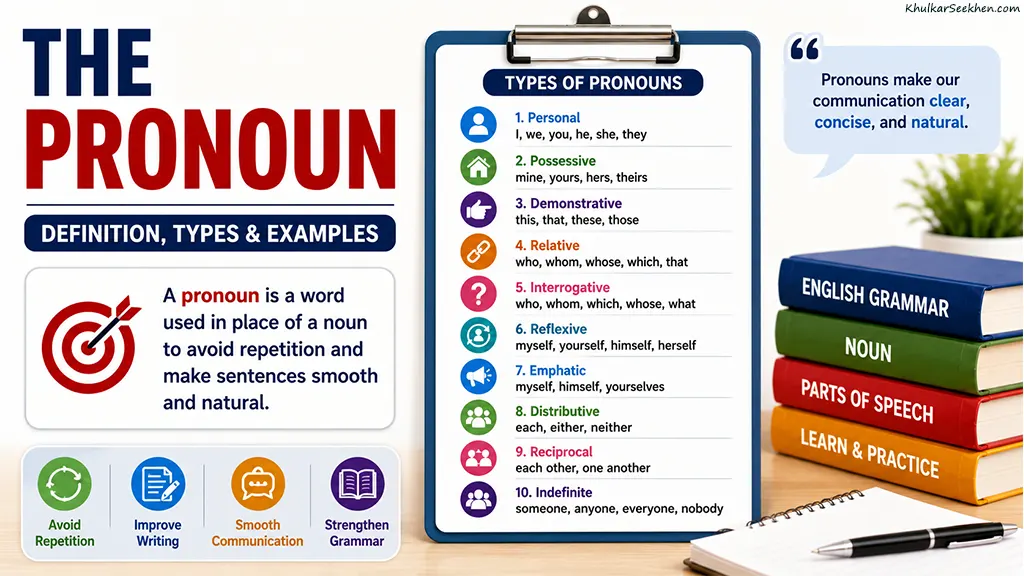
A pronoun is a word that is used in place of a noun to avoid repetition and make sentences more natural.
Common Examples
- I
- you
- he
- she
- it
- we
- they
- me
- him
- her
- them
Examples of Pronouns
| Noun | Pronoun |
|---|---|
| Dr. A. P. J. Abdul Kalam | He |
| Nikita | She |
| The soldiers | They |
| The Ganga | It |
| The weather | It |
| The children | They |
More Examples:
- Dr. A. P. J. Abdul Kalam was a great scientist. He inspired millions.
- Soldiers protect our country. They are brave.
- The Ganga is a holy river. It originates from Gangotri Glacier.
Why Do We Use Pronouns?
Pronouns help us:
- Avoid repeating the same noun.
- Make sentences shorter and smoother.
- Improve writing and speaking.
- Make communication more natural.
Types of Pronouns
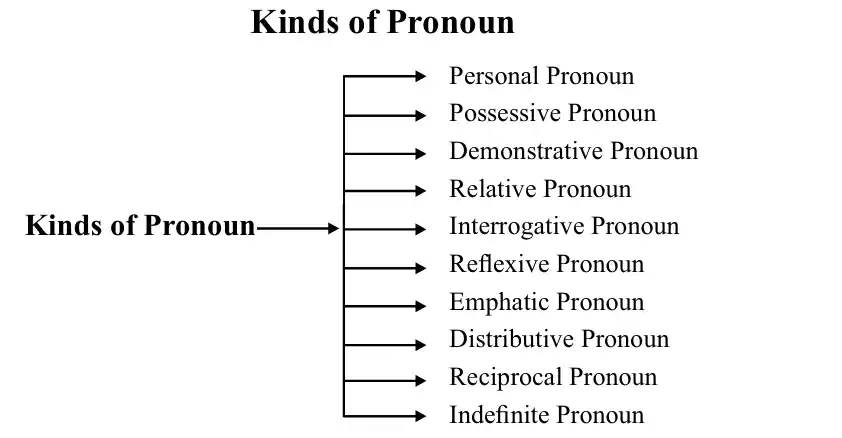
Traditional English grammar classifies pronouns into ten main types:
- Personal Pronoun
- Possessive Pronoun
- Demonstrative Pronoun
- Relative Pronoun
- Interrogative Pronoun
- Reflexive Pronoun
- Emphatic Pronoun
- Distributive Pronoun
- Reciprocal Pronoun
- Indefinite Pronoun
Let’s learn each type briefly.
1. Personal Pronoun
Personal Pronouns refer to the speaker, the listener, or the person or thing being talked about.
Definition
A Personal Pronoun is a pronoun that replaces the name of a person, animal, place, or thing and functions as the subject or object of a sentence.
Examples
- I read this book.
- You are my best friend.
- We are ready.
- They won the match.
Persons of Personal Pronouns
| Person | Meaning | Pronouns |
|---|---|---|
| First Person | Speaker | I, we |
| Second Person | Listener | you |
| Third Person | Person or thing being talked about | he, she, it, they |
Forms of Personal Pronouns
| Subject | Object | Possessive Adjective | Possessive Pronoun |
|---|---|---|---|
| I | me | my | mine |
| We | us | our | ours |
| You | you | your | yours |
| He | him | his | his |
| She | her | her | hers |
| It | it | its | – |
| They | them | their | theirs |
Examples:
- She is a doctor. (Subject)
- I met her yesterday. (Object)
- This is her bag. (Possessive Adjective)
- This bag is hers. (Possessive Pronoun)
2. Possessive Pronoun
A Possessive Pronoun shows ownership or possession without being followed by a noun.
Definition
A Possessive Pronoun is a pronoun that shows possession without being followed by a noun.
Examples
- This pen is mine.
- That house is yours.
- These books are ours.
- The decision was theirs.
Possessive Adjective vs Possessive Pronoun
Compare these sentences.
This dress is hers.
This is her dress.
| Possessive Adjective | Possessive Pronoun |
|---|---|
| my book | the book is mine |
| your car | the car is yours |
| her dress | the dress is hers |
| their house | the house is theirs |
Important Note:
Possessive pronouns never use an apostrophe (‘s).
✔ yours
✔ hers
✔ theirs
❌ your’s
❌ her’s
❌ their’s
Remember: Possessive pronouns never take an apostrophe (its, yours, hers, theirs).
| Person | Subject | Object | Possessive |
|---|---|---|---|
| First Person | I, We | me, us | my, mine, our, ours |
| Second Person | You | you | your, yours |
| Third Person | He, She, It, They | him, her, it, them | his, her, its, their/theirs |
3. Demonstrative Pronoun
A Demonstrative Pronoun points to a specific person or thing.
Definition
A Demonstrative Pronoun is a pronoun used to point out or identify a person, place, animal, or thing.
Read the following sentences:
a. This is my book.
b. That is your cap.
c. These are our neighbours.
d. Those are wild animals and are very dangerous.
In these sentences, this, that, these and those are used to indicate a person, animal, thing or place. All these are demonstrative pronouns.
Examples
- This is my book.
- That is your bicycle.
- These are my friends.
- Those are beautiful mountains.
Usage
| Pronoun | Used For |
|---|---|
| This | One thing near the speaker |
| These | More than one thing near the speaker |
| That | One thing far from the speaker |
| Those | More than one thing far from the speaker |
4. Relative Pronoun
A Relative Pronoun connects two parts of a sentence and refers back to a noun mentioned earlier.
Definition
A Relative Pronoun joins two clauses and relates one clause to a noun or pronoun in another clause.
Common Relative Pronouns
- who
- whom
- whose
- which
- that
Examples
- The boy who won the race is my friend.
- The woman whom I met was kind.
- This is the book that I borrowed.
- The dog which barked all night is ours.
- I know the girl whose father is a doctor.
Note: The word what is generally not classified as a relative pronoun in modern grammar because it means “the thing(s) that.” It does not refer back to an earlier noun.
Example:
✔ What you said is true.
5. Interrogative Pronoun
An Interrogative Pronoun is used to ask questions.
Examples
- Who is your teacher?
- Whom did you meet?
- Which is your bag?
- Whose is this notebook?
- What happened?
Note: The answer to an interrogative pronoun is usually a noun or a pronoun.
6. Reflexive Pronoun
A Reflexive Pronoun is used when the subject and the object of a sentence refer to the same person or thing.
Examples
- I hurt myself.
- She blamed herself.
- They enjoyed themselves.
- The bird built its nest itself.
7. Emphatic Pronoun
An Emphatic Pronoun is used to emphasize the subject.
Examples
- I myself completed the project.
- The Principal himself welcomed the guests.
- The children themselves cleaned the classroom.
Difference Between Reflexive and Emphatic Pronouns
| Reflexive | Emphatic |
|---|---|
| The action reflects back on the subject. | Gives emphasis to the subject. |
| She hurt herself. | She herself completed the work. |
Although the words are the same (myself, yourself, himself, etc.), their functions are different.
Reflexive Pronoun Chart
| Personal Pronoun | Reflexive Pronoun |
|---|---|
| I | myself |
| You | yourself |
| He | himself |
| She | herself |
| It | itself |
| We | ourselves |
| You (plural) | yourselves |
| They | themselves |
8. Distributive Pronoun
A Distributive Pronoun refers to persons or things one at a time.
Examples
- Each of the boys received a prize.
- Either of the answers is correct.
- Neither of the roads is safe.
Usage
- Each → Every one individually
- Either → One of the two
- Neither → Not one and not the other
These pronouns are usually treated as singular.
9. Reciprocal Pronoun
A Reciprocal Pronoun shows a mutual relationship between two or more people.
Examples
- Arnav and Anshul help each other.
- The team members supported one another.
Traditional Rule
- Each other → Two persons
- One another → More than two persons
Modern English Note: In present-day English, these two expressions are often used interchangeably.
10. Indefinite Pronoun
An Indefinite Pronoun refers to people or things in a general or non-specific way.
Examples
- Anyone can participate.
- Nobody was absent.
- Someone is waiting outside.
- Nothing is impossible.
- Everything is ready.
Common Indefinite Pronouns
- someone
- somebody
- anyone
- anybody
- everyone
- everybody
- nobody
- nothing
- everything
- few
- many
- several
- all
- most
Quick Summary of the Types of Pronouns
| Type | Function | Example |
|---|---|---|
| Personal | Replaces a noun | he, she |
| Possessive | Shows ownership | mine |
| Demonstrative | Points out | this |
| Relative | Connects clauses | who |
| Interrogative | Asks questions | what |
| Reflexive | Action returns to subject | myself |
| Emphatic | Gives emphasis | himself |
| Distributive | Refers to one at a time | each |
| Reciprocal | Shows mutual action | each other |
| Indefinite | Refers generally | someone |
Summary
- A pronoun replaces a noun.
- Pronouns make sentences shorter and avoid unnecessary repetition.
- English grammar traditionally has ten main types of pronouns.
- The correct choice of pronoun depends on its function in the sentence.
- Understanding pronouns helps improve both grammar and writing skills.
Practice Exercise 1
Identify the pronoun and its type.
- I myself solved the puzzle.
- She hurt herself while cooking.
- He who works hard succeeds.
- Helen and I were present.
- Each of the players received a medal.
- Here is the book that you gave me.
- Someone knocked at the door.
- Nobody answered the question.
- Which of these is your notebook?
- The two friends helped each other.
Practice Exercise 2
Choose the correct answer.
- Which type of pronoun is mine?
- (a) Personal
- (b) Possessive
- (c) Demonstrative
- (d) Reflexive
- Which pronoun is used to point out a person or thing?
- (a) Demonstrative
- (b) Relative
- (c) Interrogative
- (d) Reciprocal
- Which pronoun joins two clauses?
- (a) Relative
- (b) Possessive
- (c) Personal
- (d) Emphatic
- Which pronoun shows mutual action?
- (a) Reflexive
- (b) Reciprocal
- (c) Demonstrative
- (d) Distributive
- Which pronoun refers to a person or thing in a general way?
- (a) Personal
- (b) Relative
- (c) Indefinite
- (d) Demonstrative
Answers Exercise 1
- I → Personal Pronoun; myself → Emphatic Pronoun
- She → Personal Pronoun; herself → Reflexive Pronoun
- He → Personal Pronoun; who → Relative Pronoun
- I → Personal Pronoun
- Each → Distributive Pronoun
- that → Relative Pronoun; you → Personal Pronoun
- Someone → Indefinite Pronoun
- Nobody → Indefinite Pronoun
- Which → Interrogative Pronoun
- each other → Reciprocal Pronoun
Answers Exercise 2
- (b) Possessive Pronoun
- (a) Demonstrative Pronoun
- (a) Relative Pronoun
- (b) Reciprocal Pronoun
- (c) Indefinite Pronoun
