An adjective is a word that adds meaning to a noun or pronoun by describing its quality, quantity, number, possession, or other characteristics.
Without adjectives, our sentences would be plain and less informative.
Compare the following sentences:
- Vikramaditya was a king.
- Vikramaditya was a wise king.
The second sentence gives us more information because the word wise describes the noun king.
What is an Adjective?
Read the following examples:
- Rani is an intelligent girl.
- He is a brave soldier.
- Kiran bought a beautiful dress.
- I have two chocolates.
The highlighted words describe or limit the nouns.
Definition
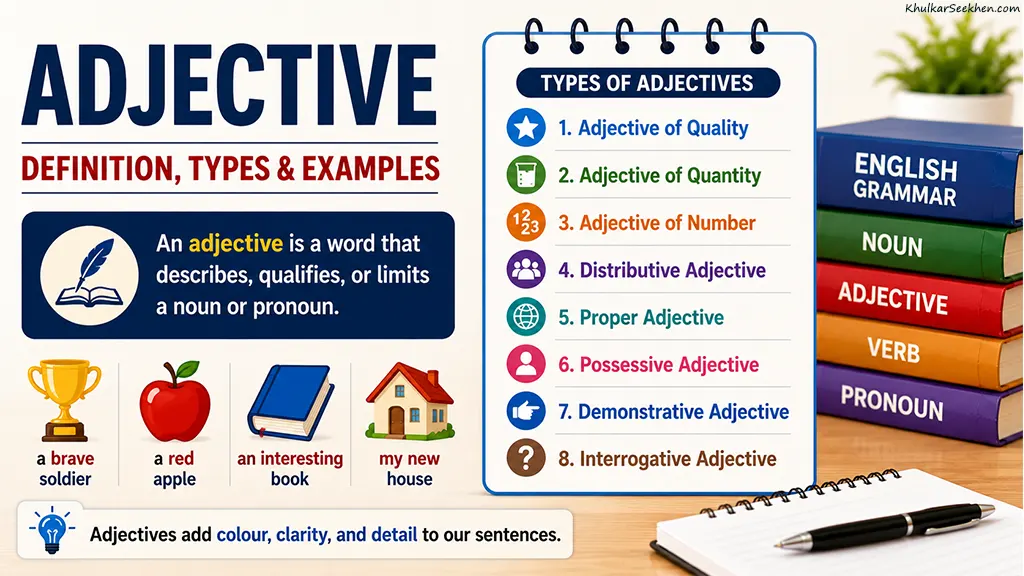
An adjective is a word that describes, qualifies, or limits a noun or pronoun.
It tells us:
- What kind?
- Which one?
- How many?
- How much?
- Whose?
Examples of Adjectives
| Sentence | Adjective | Noun Described |
|---|---|---|
| Rani is an intelligent girl. | intelligent | girl |
| He is a brave soldier. | brave | soldier |
| My mother is a religious lady. | religious | lady |
| Kiran bought a beautiful dress. | beautiful | dress |
| I have two chocolates. | two | chocolates |
Adjectives can also come after a linking verb.
Examples:
- Raghav is wise.
- She looks happy.
- The sky became dark.
Types of Adjectives
There are eight main types of adjectives.
- Adjective of Quality
- Adjective of Quantity
- Adjective of Number
- Distributive Adjective
- Proper Adjective
- Possessive Adjective
- Demonstrative Adjective
- Interrogative Adjective
1. Adjective of Quality
An Adjective of Quality tells us what kind of person or thing someone or something is.
Definition: An adjective of quality describes the nature or quality of a noun or pronoun.
It may describe:
- colour
- size
- shape
- age
- nationality
- material
- feelings
- character
Examples:
- The cake is delicious.
- It is a cold day.
- He is intelligent.
- The Ganga is a holy river.
- An old man crossed the road.
Question answered:
What kind?
2. Adjective of Quantity
An Adjective of Quantity tells us how much of something there is.
It is generally used with uncountable nouns.
Examples:
- There is enough water.
- I have little patience.
- We drank the whole milk.
- She added some sugar.
Common words:
- much
- little
- enough
- sufficient
- whole
- half
- some
Question answered:
How much?
3. Adjective of Number
An Adjective of Number tells us how many or which one.
It is generally used with countable nouns.
There are two kinds.
(a) Definite Numeral Adjective
These tell the exact number or order.
Cardinal Numbers:
- one
- two
- five
- hundred
Examples:
- I bought five books.
- Give me two pens.
Ordinal Numbers:
- first
- second
- third
- tenth
Examples:
- Sunday is the first day of the week.
- She secured the second position.
(b) Indefinite Numeral Adjective
These do not tell the exact number.
Examples:
- Some students
- Many people
- Several books
- Few children
- Most players
Question answered:
How many?
Difference Between Quantity and Number
| Adjective of Quantity | Adjective of Number |
|---|---|
| Used with uncountable nouns | Used with countable nouns |
| some water | some students |
| much milk | many books |
| little sugar | few children |
4. Distributive Adjective
Distributive adjectives refer to members of a group one at a time.
Examples:
- Each student received a prize.
- Every child deserves education.
- Either answer is correct.
- Neither road is safe.
- Any student may participate.
Usage:
Each → Every individual separately
Every → All members considered individually
Either → One of the two
Neither → Not one and not the other
Difference Between Each and Every
| Each | Every |
|---|---|
| Refers to individuals separately | Refers to all members collectively |
| Each student received a certificate. | Every student passed the exam. |
5. Proper Adjective
A Proper Adjective is formed from a Proper Noun.
Like proper nouns, it always begins with a capital letter.
Examples:
- Indian culture
- Japanese car
- Chinese products
- Kashmiri shawl
- Christian philosophy
6. Possessive Adjective
Possessive adjectives show ownership. They always come before a noun.
Examples:
- My book
- Your house
- His bag
- Her dress
- Our school
- Their car
- Its tail
Possessive Adjective vs Possessive Pronoun
| Possessive Adjective | Possessive Pronoun |
|---|---|
| my book | the book is mine |
| your bag | the bag is yours |
| her dress | the dress is hers |
| our school | the school is ours |
Remember: Possessive adjectives are followed by nouns. Possessive pronouns are not.
7. Demonstrative Adjective
Demonstrative adjectives point out particular nouns.
Examples:
- This book
- That house
- These shoes
- Those flowers
Demonstrative Adjective vs Demonstrative Pronoun
| Demonstrative Adjective | Demonstrative Pronoun |
|---|---|
| This book is mine. | This is mine. |
| Those flowers smell sweet. | Those are beautiful. |
If a noun follows this, that, these, those, they function as adjectives.
8. Interrogative Adjective
Interrogative adjectives are used with nouns to ask questions.
Examples:
- Which book is yours?
- What colour do you like?
- Whose pen is this?
If a noun follows what, which, or whose, they function as adjectives.
Degrees of Comparison
Adjectives can also compare people or things.
There are three degrees of comparison.
| Degree | Example |
|---|---|
| Positive | tall |
| Comparative | taller |
| Superlative | tallest |
Examples
- Aman is a tall boy.
- Aman is taller than Rohan.
- Aman is the tallest boy in the class.
Formation of Degrees
Add -er and -est
- tall → taller → tallest
- sweet → sweeter → sweetest
- brave → braver → bravest
Change y to i
- happy → happier → happiest
- heavy → heavier → heaviest
Double the Final Consonant
- hot → hotter → hottest
- big → bigger → biggest
Use more and most
- beautiful → more beautiful → most beautiful
- intelligent → more intelligent → most intelligent
- difficult → more difficult → most difficult
Irregular Degrees
| Positive | Comparative | Superlative |
|---|---|---|
| good | better | best |
| bad | worse | worst |
| little | less | least |
| much/many | more | most |
| far | farther/further | farthest/furthest |
Order of Adjectives (Advanced)
When more than one adjective describes a noun, English usually follows this order:
Opinion → Size → Age → Shape → Colour → Origin → Material → Purpose → Noun
Example:
✔ A beautiful small old round brown Indian wooden dining table.
Common Mistakes
❌ more better
✔ better
❌ most tallest
✔ tallest
❌ an European country
✔ a European country
❌ He is more smarter than me.
✔ He is smarter than me.
❌ I have much books.
✔ I have many books.
Summary
- An adjective describes or limits a noun or pronoun.
- There are eight main types of adjectives.
- Adjectives answer questions such as what kind, how much, how many, which, and whose.
- Adjectives also have three degrees of comparison: Positive, Comparative, and Superlative.
- Correct use of adjectives makes writing more descriptive, precise, and effective.
Practice Exercise 1
Identify the adjective and its type.
- India’s population is the largest in the world.
- Kishan is an intelligent boy.
- I need some water.
- Every child deserves education.
- This book belongs to me.
- Which colour do you prefer?
- I bought five apples.
- She is wearing a Kashmiri shawl.
- His bicycle is very expensive.
- Those flowers are beautiful.
Practice Exercise 2
Choose the correct answer.
- Which type of adjective is beautiful?
- (a) Quality
- (b) Quantity
- (c) Number
- (d) Proper
- Which adjective answers How many?
- (a) Adjective of Number
- (b) Adjective of Quantity
- (c) Possessive Adjective
- (d) Demonstrative Adjective
- Which is a Proper Adjective?
- (a) Indian
- (b) beautiful
- (c) three
- (d) some
- Which sentence contains a Demonstrative Adjective?
- (a) This is my bag.
- (b) This bag is heavy.
- (c) Mine is blue.
- (d) She is honest.
- Which is the comparative form of good?
- (a) gooder
- (b) better
- (c) best
- (d) more good
Answers Exercise 1
- largest → Adjective of Quality (Superlative Degree)
- intelligent → Adjective of Quality
- some → Adjective of Quantity
- Every → Distributive Adjective
- This → Demonstrative Adjective
- Which → Interrogative Adjective
- five → Adjective of Number (Cardinal)
- Kashmiri → Proper Adjective
- His → Possessive Adjective; expensive → Adjective of Quality
- Those → Demonstrative Adjective; beautiful → Adjective of Quality
Answers Exercise 2
- (a) Adjective of Quality
- (a) Adjective of Number
- (a) Indian
- (b) This bag is heavy.
- (b) better
