A verb is the heart of every sentence. It tells us what someone or something does, what happens, or what state someone or something is in.
Without a verb, a complete sentence cannot be formed.
For example:
- Birds fly.
- The baby is sleeping.
- She writes beautifully.
- The sun rises in the east.
The highlighted words are verbs because they express an action, occurrence, or state.
What is a Verb?
Read the following sentences.
- A kabaddi player chants, “Kabaddi, Kabaddi…”
- My grandfather makes delicious snacks.
- The duck swims in the river.
- The sun rises in the east.
The words chants, makes, swims, and rises tell us what the subject is doing.
Definition
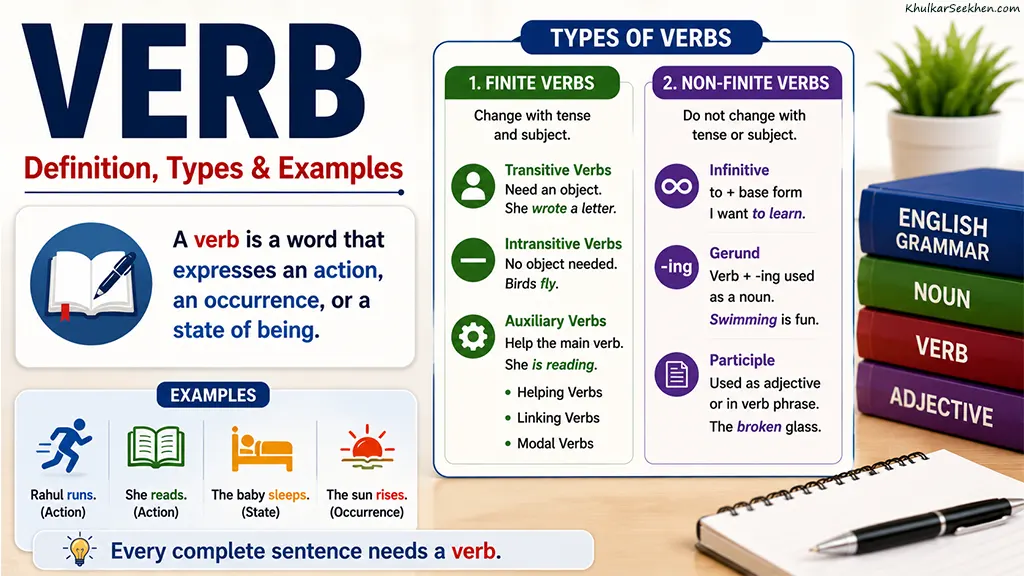
A verb is a word that expresses an action, an occurrence, or a state of being.
Examples
| Sentence | Verb |
|---|---|
| Riya sings beautifully. | sings |
| Birds fly in the sky. | fly |
| The baby is sleeping. | is sleeping |
| He became a doctor. | became |
| They are happy. | are |
Important: Every complete sentence must contain a verb.
Why Are Verbs Important?
A verb tells us:
- What someone does
- What happens
- The condition or state of a person or thing
- The time of an action (present, past, or future)
Without a verb, a sentence is incomplete.
❌ Rahul a good boy.
✔ Rahul is a good boy.
Classification of Verbs
The following chart shows the main types of verbs in English grammar.
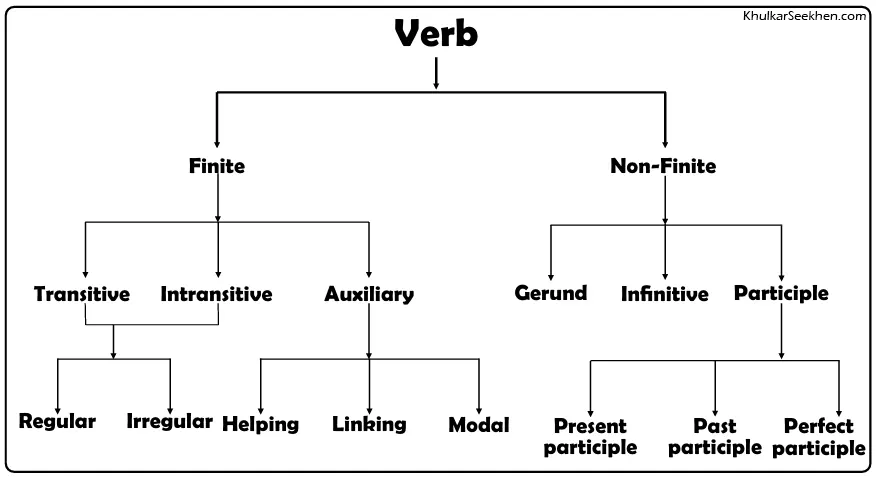
Overview of Verb Classification
Verb
│
├── Finite Verbs
│   ├── Transitive Verbs
│   ├── Intransitive Verbs
│   └── Auxiliary Verbs
│       ├── Helping Verbs
│       ├── Linking Verbs
│       └── Modal Verbs
│
└── Non-finite Verbs
    ├── Infinitive
    ├── Gerund
    └── Participle
        ├── Present Participle
        ├── Past Participle
        └── Perfect Participle
Let’s briefly understand each type.
1. Finite Verbs
A Finite Verb changes its form according to:
- Person
- Number
- Tense
It acts as the main verb of a sentence.
Examples
- I play football.
- She plays football.
- They played football yesterday.
Notice how the verb changes according to the subject and tense.
Finite verbs are discussed in detail in the next lesson.
Types of Finite Verbs
Transitive Verbs
These verbs require an object to complete their meaning.
Example:
- She wrote a letter.
- The police arrested the thief.
Intransitive Verbs
These verbs do not require an object.
Examples:
- Birds fly.
- The baby slept.
- It rained yesterday.
Auxiliary Verbs
Auxiliary (Helping) Verbs help the main verb express tense, voice, mood, or emphasis.
Examples:
- She is reading.
- They have arrived.
- We will succeed.
Auxiliary verbs include:
- Helping Verbs
- Linking Verbs
- Modal Verbs
Each of these will be studied separately.
2. Non-finite Verbs
A Non-finite Verb does not change according to person, number, or tense.
Unlike finite verbs, it cannot act as the main verb of an independent sentence.
Examples:
- Walking is good exercise.
- I like to read.
- The broken window was repaired.
The words walking, to read, and broken are non-finite verbs.
Types of Non-finite Verbs
Infinitive
Usually formed by to + base form of the verb.
Examples:
- to read
- to write
- to help
Example sentence:
- I want to learn English.
Gerund
A Gerund is the -ing form of a verb used as a noun.
Examples:
- Reading is enjoyable.
- Swimming keeps you fit.
Participle
A Participle is a verb form that functions as an adjective or helps form verb tenses.
Examples:
- Running water
- Broken glass
- Having completed the work
There are three kinds of participles:
- Present Participle
- Past Participle
- Perfect Participle
Verb Forms (Principal Parts of a Verb)
Every main verb has different forms.
| Form | Name | Example (Write) |
|---|---|---|
| V1 | Base Form | write |
| V2 | Past Form | wrote |
| V3 | Past Participle | written |
| V4 | Present Participle | writing |
| V5 | Third Person Singular | writes |
Another Example
| V1 | V2 | V3 | V4 | V5 |
|---|---|---|---|---|
| go | went | gone | going | goes |
Learning these forms is essential for using tenses correctly.
Action Verbs and State Verbs
Verbs can also be classified by meaning.
Action Verbs
They show an action.
Examples:
- run
- dance
- sing
- jump
- write
Sentence:
- Rahul runs every morning.
State (Stative) Verbs
They describe a state, feeling, possession, or thought rather than an action.
Examples:
- know
- believe
- love
- own
- seem
- understand
Sentence:
- I know the answer.
- She owns a car.
Quick Summary
| Type | Function | Example |
|---|---|---|
| Finite Verb | Changes with tense and subject | plays |
| Transitive Verb | Needs an object | wrote a letter |
| Intransitive Verb | No object needed | sleeps |
| Auxiliary Verb | Helps the main verb | is reading |
| Infinitive | to + verb | to read |
| Gerund | Verb + ing used as noun | Reading is fun. |
| Participle | Verb used as adjective or in verb phrase | broken glass |
Common Mistakes
❌ He go to school.
✔ He goes to school.
❌ She is know the answer.
✔ She knows the answer.
❌ I enjoy to swim.
✔ I enjoy swimming.
❌ He made me to laugh.
✔ He made me laugh.
Summary
- A verb expresses an action, occurrence, or state of being.
- Every complete sentence requires a verb.
- Verbs are broadly classified into Finite and Non-finite verbs.
- Finite verbs change according to the subject and tense.
- Non-finite verbs do not change according to person, number, or tense.
- Understanding verbs is the foundation for learning tenses, voice, narration, and sentence structure.
Practice Exercise 1
Identify the verb in each sentence and state whether it is a Finite or Non-finite Verb.
- Birds fly in the sky.
- Reading improves vocabulary.
- She wants to become a doctor.
- The broken chair was repaired yesterday.
- They have completed the project.
- Swimming is my favourite hobby.
- I saw a crying child.
- We will visit Jaipur next month.
- The teacher asked us to write neatly.
- Having finished the work, he went home.
Practice Exercise 2
Choose the correct answer.
- Which of the following is a finite verb?
- (a) to read
- (b) reading
- (c) reads
- (d) written
- Which is a non-finite verb?
- (a) plays
- (b) went
- (c) swimming
- (d) writes
- Which type of verb requires an object?
- (a) Intransitive
- (b) Transitive
- (c) Linking
- (d) Modal
- Which verb helps the main verb?
- (a) Auxiliary
- (b) Gerund
- (c) Participle
- (d) Infinitive
- Which verb form is called the past participle?
- (a) V1
- (b) V2
- (c) V3
- (d) V4
Answers Exercise 1
- fly → Finite Verb
- Reading → Non-finite Verb (Gerund)
- wants → Finite Verb; to become → Non-finite Verb (Infinitive)
- broken → Non-finite Verb (Participle); was repaired → Finite Verb
- have completed → Finite Verb
- Swimming → Non-finite Verb (Gerund)
- saw → Finite Verb; crying → Non-finite Verb (Present Participle)
- will visit → Finite Verb
- asked → Finite Verb; to write → Non-finite Verb (Infinitive)
- Having finished → Non-finite Verb (Perfect Participle); went → Finite Verb
Answers Exercise 2
- (c) reads
- (c) swimming
- (b) Transitive
- (a) Auxiliary
- (c) V3
