In the previous lesson, we learned that verbs are broadly divided into Finite Verbs and Non-finite Verbs.
Understanding the difference between these two types is essential because it forms the foundation for learning tenses, voice, narration, gerunds, infinitives, and participles.
In this lesson, you will learn:
- What are Finite Verbs?
- What are Non-finite Verbs?
- Differences between them
- Types of Non-finite Verbs
- Examples
- Common mistakes
- Exercises with answers
What is a Finite Verb?
Read the following sentences.
- We play football every evening.
- Geeta plays football every evening.
- Rajat played football yesterday.
Notice the highlighted verbs:
- play
- plays
- played
The verb changes according to:
- Subject
- Number
- Person
- Tense
These are Finite Verbs.
Definition
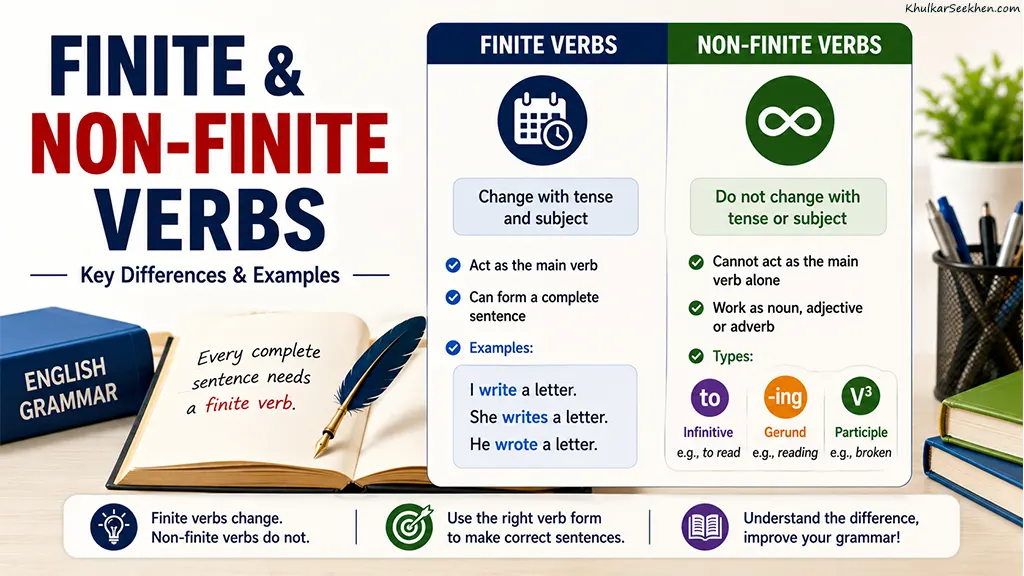
A Finite Verb is a verb that changes its form according to the person, number, tense, or mood of the subject and can function as the main verb of a sentence.
Every complete sentence must have at least one finite verb.
Examples
| Sentence | Finite Verb |
|---|---|
| I am happy. | am |
| She sings beautifully. | sings |
| They were playing. | were playing |
| Rahul goes to school. | goes |
| We have finished the work. | have finished |
Characteristics of Finite Verbs
A finite verb:
- Changes according to tense.
- Changes according to the subject.
- Expresses the main action or state.
- Can form a complete sentence.
Example:
| Subject | Verb |
|---|---|
| I | write |
| He | writes |
| They | wrote |
What is a Non-finite Verb?
Read these sentences.
- He loves walking.
- They love walking.
- She loved walking.
The verb walking remains the same in every sentence.
It does not change according to:
- Subject
- Person
- Number
- Tense
Therefore, walking is a Non-finite Verb.
Definition
A Non-finite Verb is a verb that does not change its form according to the subject or tense and cannot function as the main verb of an independent sentence.
Non-finite verbs often work as nouns, adjectives, or adverbs.
Examples
- Walking is good exercise.
- I like to read.
- The broken window was repaired.
- Having finished the work, he left.
The highlighted words are non-finite verbs.
Difference Between Finite and Non-finite Verbs
| Finite Verb | Non-finite Verb |
|---|---|
| Changes according to tense | Does not change according to tense |
| Changes according to subject | Does not change according to subject |
| Acts as the main verb | Cannot act as the main verb alone |
| Forms a complete sentence | Needs a finite verb in the sentence |
| Example: writes | Example: writing |
Examples
Example 1:
Rahul is reading a newspaper.
Finite Verb: is reading
There is no non-finite verb here because is reading together forms the finite verb phrase.
Example 2:
Rahul likes reading.
Finite Verb: likes
Non-finite Verb: reading (Gerund)
Example 3:
She wants to become a doctor.
Finite Verb: wants
Non-finite Verb: to become (Infinitive)
Example 4:
The broken chair was repaired.
Finite Verb: was repaired
Non-finite Verb: broken (Past Participle)
Types of Non-finite Verbs
There are three types of non-finite verbs.
- Infinitive
- Gerund
- Participle
These are discussed briefly below and explained in detail in later lessons.
1. Infinitive
An Infinitive is usually formed by to + base form of the verb.
Examples:
- to read
- to write
- to play
Sentence:
- I want to study.
2. Gerund
A Gerund is the -ing form of a verb used as a noun.
Examples:
- Reading
- Swimming
- Dancing
Sentence:
- Reading improves knowledge.
3. Participle
A Participle is a verb form that functions as an adjective or helps form verb tenses.
Examples:
- running water
- broken glass
- smiling child
How to Identify a Finite Verb
Ask these questions:
→ Does the verb change according to the subject?
- play
- plays
Yes; Finite Verb
→ Does it change according to tense?
- play
- played
Yes; Finite Verb
→ Can it make a complete sentence?
Example
Birds fly.
Yes; Finite Verb
How to Identify a Non-finite Verb
Ask these questions:
→ Does the verb remain unchanged?
Examples
- walking
- to read
- broken
Yes; Non-finite Verb
Common Mistakes
✘ Reading books.
✔ Reading books is enjoyable.
✘ To play football.
✔ I like to play football.
✘ Walking to school every day.
✔ Walking to school every day keeps us healthy.
Quick Revision Table
| Feature | Finite Verb | Non-finite Verb |
|---|---|---|
| Changes with tense | ✔ | ✘ |
| Changes with subject | ✔ | ✘ |
| Main verb | ✔ | ✘ |
| Can function as noun | ✘ | ✔ |
| Can function as adjective | ✘ | ✔ |
Summary
- Verbs are divided into Finite and Non-finite verbs.
- A finite verb changes according to the subject and tense and forms the main verb of a sentence.
- A non-finite verb does not change according to the subject or tense.
- There are three main types of non-finite verbs:
- Infinitive
- Gerund
- Participle
- Understanding this distinction is essential for mastering English grammar.
Practice Exercise 1
Identify the Finite and Non-finite Verbs in the following sentences.
- Reading books improves vocabulary.
- She wants to become a doctor.
- The crying baby needs attention.
- Having completed the homework, he went outside.
- They are playing football.
- I enjoy swimming every morning.
- The broken chair was repaired yesterday.
- We hope to meet you soon.
- Singing is my favourite hobby.
- The children were laughing loudly.
Practice Exercise 2
Choose the correct answer.
- Which of the following is a finite verb?
- (a) to write
- (b) writing
- (c) writes
- (d) written
- Which is a non-finite verb?
- (a) goes
- (b) went
- (c) going
- (d) goes on
- Which type of non-finite verb acts as a noun?
- (a) Participle
- (b) Gerund
- (c) Auxiliary
- (d) Finite Verb
- Which type of non-finite verb usually begins with to?
- (a) Gerund
- (b) Participle
- (c) Infinitive
- (d) Auxiliary
- Which statement is correct?
- (a) A finite verb never changes its form.
- (b) A non-finite verb changes according to the subject.
- (c) A finite verb changes according to tense and subject.
- (d) Every non-finite verb can form a complete sentence.
Answers Exercise 1
- Reading → Non-finite (Gerund); improves → Finite
- wants → Finite; to become → Non-finite (Infinitive)
- crying → Non-finite (Present Participle); needs → Finite
- Having completed → Non-finite (Perfect Participle); went → Finite
- are playing → Finite
- enjoy → Finite; swimming → Non-finite (Gerund)
- broken → Non-finite (Past Participle); was repaired → Finite
- hope → Finite; to meet → Non-finite (Infinitive)
- Singing → Non-finite (Gerund); is → Finite
- were laughing → Finite
Answer Exercise 2
- (c) writes
- (c) going
- (b) Gerund
- (c) Infinitive
- (c) A finite verb changes according to tense and subject
