Verbs are not all used in the same way. Some verbs require an object to complete their meaning, while others express a complete idea without an object.
Based on this, verbs are divided into Transitive Verbs and Intransitive Verbs.
In this lesson, you will learn:
- What are Transitive Verbs?
- What are Intransitive Verbs?
- Difference between them
- How to identify them
- Common mistakes
- Exercises with answers
What is a Transitive Verb?
Read the following sentences.
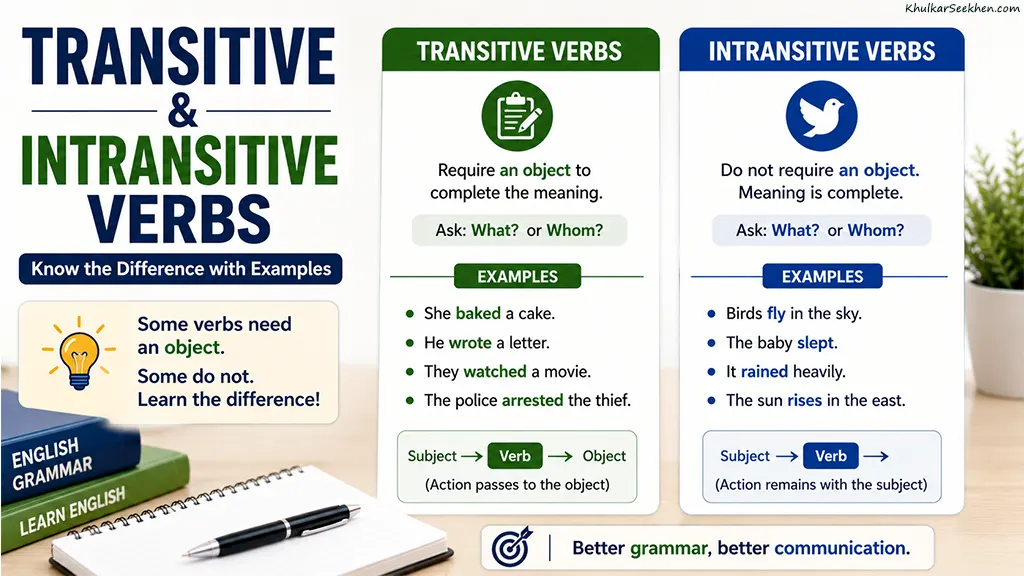
- She baked a cake.
- I want a book.
- He wrote a letter.
- The police arrested the thief.
In each sentence, the verb needs an object to complete its meaning.
For example:
She baked…
The question naturally arises:
She baked what?
A cake.
Without the object, the meaning remains incomplete.
Definition
A Transitive Verb is a verb that requires one or more objects to complete its meaning.
A transitive verb transfers its action from the subject to an object.
Examples
| Sentence | Verb | Object |
|---|---|---|
| She baked a cake. | baked | cake |
| I want a book. | want | book |
| He writes a letter. | writes | letter |
| The police arrested the thief. | arrested | thief |
| Rahul kicked the ball. | kicked | ball |
How to Identify a Transitive Verb
Ask the questions:
- What?
- Whom?
after the verb.
Examples:
→ She baked a cake.
What did she bake?
✔ A cake; Transitive Verb
→ The police arrested the thief.
Whom did the police arrest?
✔ The thief; Transitive Verb
What is an Intransitive Verb?
Read these sentences.
- Birds fly.
- The baby slept.
- It rained yesterday.
- The children laughed loudly.
The verbs
- fly
- slept
- rained
- laughed
do not require any object.
The meaning is complete without answering what or whom.
Definition
An Intransitive Verb is a verb that does not require an object to complete its meaning.
Examples
| Sentence | Verb | Object |
|---|---|---|
| Birds fly. | fly | — |
| The baby sleeps. | sleeps | — |
| It rained heavily. | rained | — |
| The children laughed. | laughed | — |
| The sun rises. | rises | — |
How to Identify an Intransitive Verb
Ask:
What?
or
Whom?
If no meaningful answer exists, the verb is intransitive.
Example
Birds fly.
Birds fly what?
No answer.
Therefore,
fly is an intransitive verb.
Difference Between Transitive and Intransitive Verbs
| Transitive Verb | Intransitive Verb |
|---|---|
| Requires an object | Does not require an object |
| Action passes to an object | Action remains with the subject |
| Answers What? or Whom? | Does not answer What? or Whom? |
| Meaning is incomplete without an object | Meaning is complete without an object |
Verbs That Can Be Both Transitive and Intransitive
Many English verbs can be used in both ways depending on the sentence.
1. Read
Transitive
- She read a novel.
Intransitive
- She was reading.
2. Sing
Transitive
- She sang a song.
Intransitive
- She sang beautifully.
3. Write
Transitive
- He wrote a letter.
Intransitive
- He writes well.
4. Eat
Transitive
- They ate their lunch.
Intransitive
- They already ate.
5. Speak
Transitive
- She speaks English.
Intransitive
- She speaks clearly.
Direct Object and Indirect Object
Some transitive verbs take two objects.
Example
My father gave me a bicycle.
Verb: gave
Indirect Object: me
Direct Object: a bicycle
Another example
The teacher taught us grammar.
Verb: taught
Indirect Object: us
Direct Object: grammar
Common Transitive Verbs
- buy
- bring
- make
- write
- read
- open
- close
- help
- build
- repair
- clean
- watch
- eat
- drink
Common Intransitive Verbs
- sleep
- arrive
- laugh
- cry
- fall
- come
- go
- die
- smile
- sit
- stand
- swim
- walk
- rain
Common Mistakes
✘ She discussed about the problem.
✔ She discussed the problem.
(Discuss is a transitive verb and does not take about.)
✘He entered into the room.
✔ He entered the room.
✘ They reached to Delhi.
✔ They reached Delhi.
✘ The baby cried tears.
✔ The baby cried.
(The object is unnecessary.)
Quick Revision Table
| Question | Transitive | Intransitive |
|---|---|---|
| Needs an object? | ✔ | ✘ |
| Action passes to object? | ✔ | ✘ |
| Answers What? | ✔ | ✘ |
| Answers Whom? | ✔ | ✘ |
Summary
- A Transitive Verb requires an object to complete its meaning.
- An Intransitive Verb does not require an object.
- Ask What? or Whom? after the verb to identify a transitive verb.
- Many English verbs can function as both transitive and intransitive, depending on how they are used in a sentence.
Practice Exercise 1
Identify whether the verb is Transitive or Intransitive.
- She baked a cake.
- Birds fly in the sky.
- The baby slept peacefully.
- He wrote a letter.
- The sun rises in the east.
- They cleaned the classroom.
- The children laughed loudly.
- We watched a movie yesterday.
- The old man smiled.
- My father repaired the bicycle.
Practice Exercise 2
Choose the correct answer.
- A transitive verb always:
- (a) has no object
- (b) requires an object
- (c) expresses only a state
- (d) ends with -ed
- Which sentence contains an intransitive verb?
- (a) She wrote a poem.
- (b) Rahul opened the door.
- (c) The baby slept peacefully.
- (d) They built a house.
- Which verb can be both transitive and intransitive?
- (a) read
- (b) laugh
- (c) rain
- (d) sleep
- In the sentence “The teacher gave us homework,” the direct object is:
- (a) teacher
- (b) us
- (c) homework
- (d) gave
- Which sentence contains a transitive verb?
- (a) The birds flew away.
- (b) The baby cried.
- (c) He kicked the ball.
- (d) It rained heavily.
Answers Exercise 1
- baked → Transitive
- fly → Intransitive
- slept → Intransitive
- wrote → Transitive
- rises → Intransitive
- cleaned → Transitive
- laughed → Intransitive
- watched → Transitive
- smiled → Intransitive
- repaired → Transitive
Answers Exercise 2
- (b) requires an object
- (c) The baby slept peacefully.
- (a) read
- (c) homework
- (c) He kicked the ball.
