Auxiliary (Helping) Verbs: Auxiliary verbs, also called Helping Verbs, are essential for forming tenses, questions, negative sentences, passive voice, and continuous actions.
They do not usually express the main action themselves. Instead, they help the main verb convey the correct meaning.
In this lesson, you will learn:
- What are Auxiliary Verbs?
- Why do we use them?
- Types of Auxiliary Verbs
- Primary Auxiliary Verbs
- Uses of Be, Have, and Do
- Difference between Main Verbs and Helping Verbs
- Common mistakes
- Exercises with answers
What is an Auxiliary Verb?
Read the following sentences.
- He is writing a letter.
- They have completed the project.
- She was singing beautifully.
- We do not agree with this decision.
In these sentences:
- is
- have
- was
- do
help the main verbs to express tense or make the sentence grammatically correct.
These are Auxiliary Verbs.
Definition
An Auxiliary Verb (Helping Verb) is a verb that helps the main verb express tense, voice, mood, emphasis, or form questions and negative sentences.
Auxiliary verbs cannot usually express the complete meaning of a sentence by themselves when used as helpers.
Examples
| Sentence | Auxiliary Verb | Main Verb |
|---|---|---|
| She is reading. | is | reading |
| We have finished the work. | have | finished |
| They were playing football. | were | playing |
| Do you know him? | do | know |
| He has written a letter. | has | written |
Why Do We Need Auxiliary Verbs?
Helping verbs are used to:
- Form different tenses
- Make negative sentences
- Ask questions
- Form passive voice
- Give emphasis
Examples:
Present Continuous
She is reading a novel.
Present Perfect
She has completed her homework.
Question
Do you play cricket?
Negative Sentence
I do not like coffee.
Passive Voice
The work was completed yesterday.
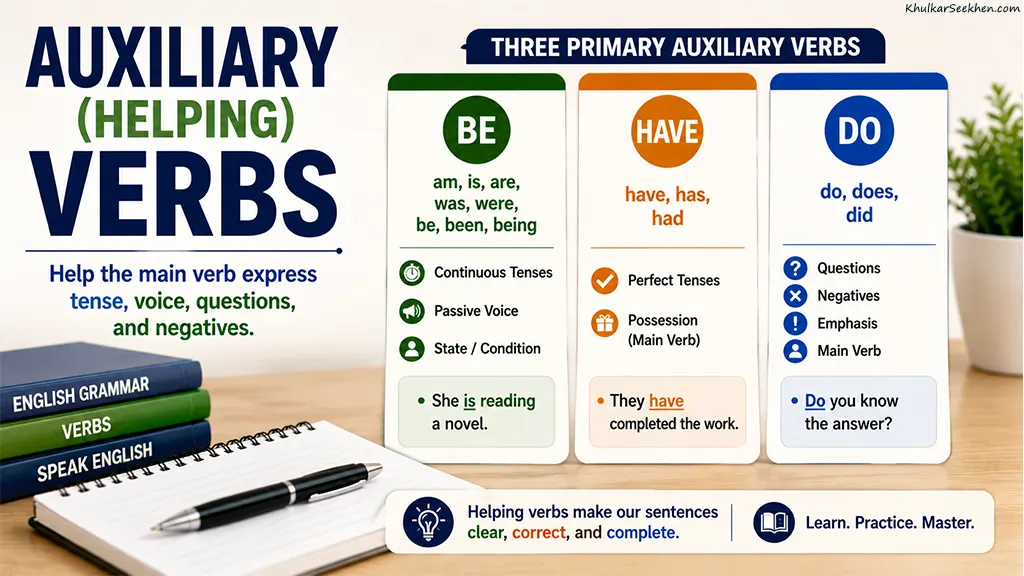
Primary Auxiliary Verbs
English has three primary auxiliary verbs.
- Be
- Have
- Do
These verbs can work as:
- Helping Verbs
- Main Verbs
1. Be Verbs
The forms of Be are:
- am
- is
- are
- was
- were
- be
- been
- being
Uses of Be
A. Continuous Tenses
- She is reading.
- They were playing football.
B. Passive Voice
- The letter was written yesterday.
- The room is cleaned every day.
C. State or Condition (Main Verb)
- I am happy.
- She is a doctor.
Here, am and is are main verbs, not helping verbs.
2. Have Verbs
Forms of Have:
- have
- has
- had
Uses of Have
A. Perfect Tenses
- I have finished my homework.
- She has gone to school.
- They had left before sunset.
B. Possession (Main Verb)
- I have a bicycle.
- She has two sisters.
Here, have and has are used as main verbs.
3. Do Verbs
Forms of Do
- do
- does
- did
Uses of Do
A. Questions
- Do you play football?
- Does he live here?
- Did they arrive yesterday?
B. Negative Sentences
- I do not like tea.
- She does not smoke.
- They did not attend the meeting.
C. Emphasis
- I do understand your problem.
- She did complete the project.
D. Main Verb
- I do my homework every day.
- She does yoga every morning.
Here, do and does express the main action.
List of Primary Auxiliary Verbs
| Auxiliary Verb | Forms |
|---|---|
| Be | am, is, are, was, were, be, been, being |
| Have | have, has, had |
| Do | do, does, did |
Main Verb vs Helping Verb
Sometimes the same verb acts as a main verb, and sometimes as a helping verb.
Example 1
She is reading.
Helping Verb: is
Main Verb: reading
Example 2
She is a doctor.
Here, is is the main verb because it directly expresses the state of the subject.
Example 3
I have completed my work.
Helping Verb: have
Main Verb: completed
Example 4
I have a new laptop.
Here, have is the main verb because it means “possess.”
Example 5
Do you know him?
Helping Verb: do
Main Verb: know
Example 6
I do my homework daily.
Main Verb: do
Auxiliary Verbs in Different Tenses
| Tense | Auxiliary | Example |
|---|---|---|
| Present Continuous | am/is/are | She is reading. |
| Past Continuous | was/were | They were playing. |
| Present Perfect | have/has | I have finished. |
| Past Perfect | had | She had left. |
| Passive Voice | be + V3 | The work was completed. |
Common Mistakes
✘ He do not like tea.
✔ He does not like tea.
✘ They is playing.
✔ They are playing.
✘ I has completed my homework.
✔ I have completed my homework.
✘ She don’t know me.
✔ She doesn’t know me.
✘ Did you went there?
✔ Did you go there?
(After did, always use the base form (V1).)
Quick Revision Table
| Auxiliary | Main Use |
|---|---|
| am/is/are | Continuous Tense, Passive Voice |
| was/were | Past Continuous, Passive Voice |
| have/has/had | Perfect Tenses |
| do/does/did | Questions, Negatives, Emphasis |
Summary
- Auxiliary verbs are also called Helping Verbs.
- They help the main verb express tense, voice, mood, and emphasis.
- The three primary auxiliary verbs are:
- Be
- Have
- Do
- These verbs can also function as main verbs, depending on their use in a sentence.
- Auxiliary verbs are essential for forming continuous tenses, perfect tenses, passive voice, questions, and negative sentences.
Practice Exercise 1
Underline the auxiliary verb and identify its type.
- She is reading a novel.
- They have completed the work.
- Do you know the answer?
- We were waiting for the bus.
- I had seen that movie before.
- He does not like coffee.
- The letter was written yesterday.
- She has won the competition.
- Are they coming today?
- I do believe you.
Practice Exercise 2
Choose the correct auxiliary verb.
- She ________ reading a story.
- (a) is
- (b) have
- (c) do
- (d) did
- ________ you completed your homework?
- (a) Is
- (b) Have
- (c) Do
- (d) Were
- He ________ not play football yesterday.
- (a) do
- (b) does
- (c) did
- (d) has
- The work ________ completed before noon.
- (a) was
- (b) do
- (c) have
- (d) has
- They ________ been waiting for two hours.
- (a) is
- (b) has
- (c) have
- (d) does
Answers Exercise 1
- is → Be Auxiliary
- have → Have Auxiliary
- Do → Do Auxiliary
- were → Be Auxiliary
- had → Have Auxiliary
- does → Do Auxiliary
- was → Be Auxiliary
- has → Have Auxiliary
- Are → Be Auxiliary
- do → Do Auxiliary (used for emphasis)
Answers Exercise 2
- (a) is
- (b) Have
- (c) did
- (a) was
- (c) have
